Updated
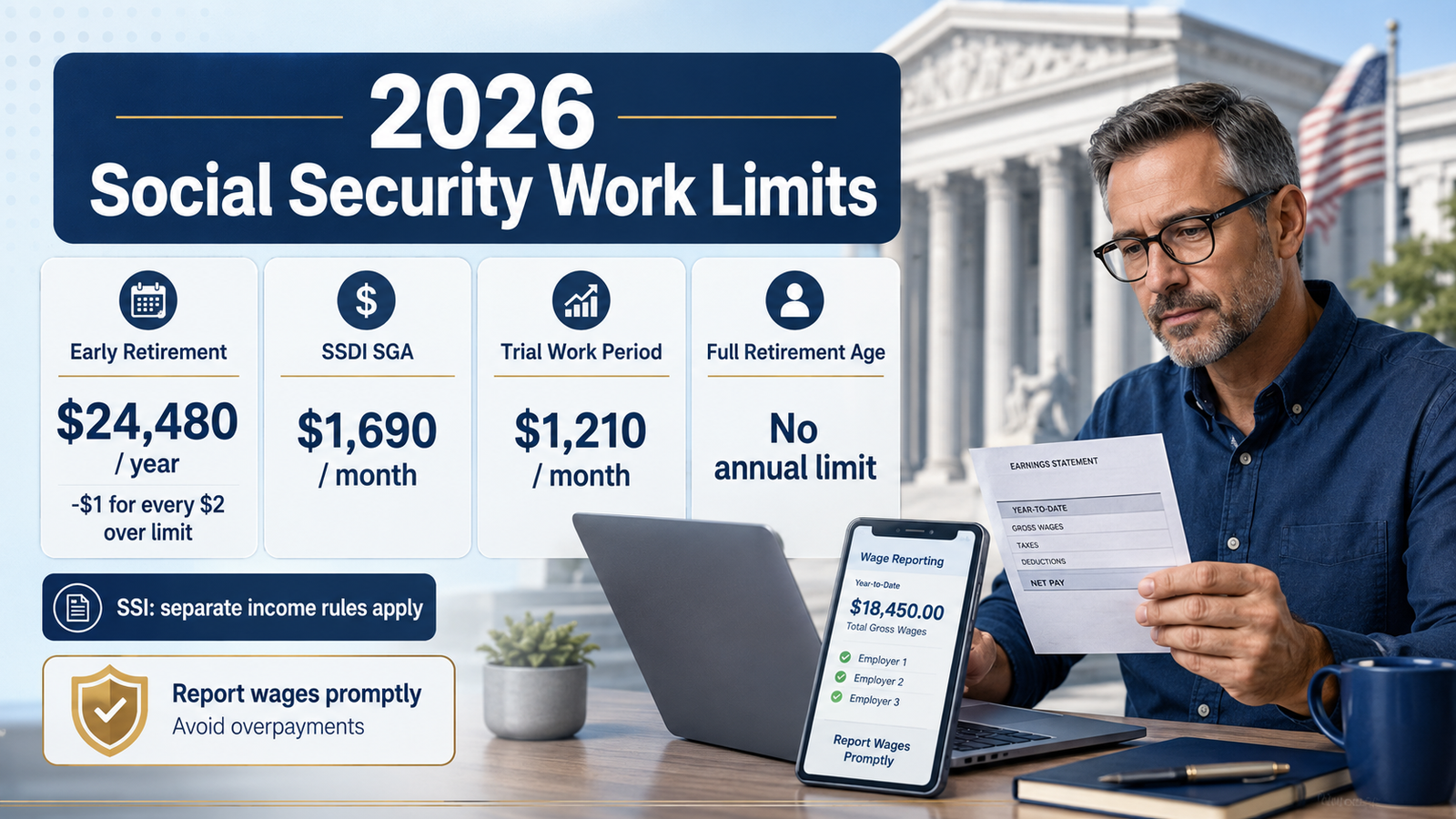
The 2026 Social Security work limits are not one universal earnings cap. Retirement benefits, Social Security Disability Insurance, and Supplemental Security Income use different rules. The retirement earnings test begins at $24,480 for many workers below full retirement age, while SSDI uses separate Trial Work Period and substantial gainful activity thresholds. SSI generally uses countable-income rules and work incentives for current recipients.
Correction: An earlier version treated SSDI and SSI work rules as simple monthly caps and incorrectly suggested that every amount above a threshold caused an immediate benefit loss. This version separates the three programs and reflects current Social Security Administration guidance.
Key Facts
- If you are under full retirement age for all of 2026, the retirement earnings-test limit is $24,480. Social Security withholds $1 in benefits for every $2 earned above that amount.
- If you reach full retirement age in 2026, the higher limit is $65,160 for earnings before the month you reach full retirement age. Social Security withholds $1 for every $3 above that amount.
- For SSDI, $1,210 in monthly earnings can make a month count toward the Trial Work Period; it is not a monthly benefit cutoff.
- The 2026 substantial gainful activity amount is $1,690 per month for non-blind individuals and $2,830 for statutorily blind individuals.
- SSI uses countable-income exclusions and work incentives rather than one simple continuing monthly work cap for current recipients.
What the 2026 Social Security Work Limits Cover
The phrase “Social Security work limit” can refer to several different rules. Applying one number to every beneficiary can produce the wrong result.
The SSA 2026 changes fact sheet lists the current retirement earnings-test, SSDI, and SSI figures.
Retirement Benefits: The $24,480 Earnings Test
If you are below full retirement age for the entire year, Social Security uses an annual retirement earnings test.
For 2026, the limit is $24,480. SSA withholds $1 in retirement benefits for every $2 of wages or net self-employment earnings above that amount.
The test generally counts wages and net self-employment income. It does not count pensions, annuities, investment income, interest, veterans benefits, or other government or military retirement benefits.
The $65,160 Rule in the Year You Reach Full Retirement Age
A different limit applies during the calendar year in which a worker reaches full retirement age.
For 2026, that limit is $65,160. SSA withholds $1 in benefits for every $3 earned above the limit, counting only earnings before the month full retirement age is reached.
Beginning with the month a worker reaches full retirement age, the retirement earnings test ends.
SSA explains the calculations and examples in its retirement benefits while working guidance.
Withheld Retirement Benefits Are Not Necessarily Lost Forever
Benefits withheld under the retirement earnings test are not treated like a permanent fine.
After full retirement age, SSA recalculates the retirement benefit to give credit for months in which benefits were reduced or withheld because of excess earnings.
SSDI: Trial Work Period Is Not the Same as SGA
SSDI uses a separate work-incentive structure.
During a Trial Work Period, a beneficiary can test returning to work for at least nine service months while continuing to receive the full SSDI payment, as long as the person continues to meet the disability requirements.
In 2026, a month with earnings over $1,210 generally counts as a Trial Work Period service month. The months do not have to be consecutive; SSA counts them within a rolling five-year period.
There is no earnings ceiling during the nine Trial Work Period months. The $1,210 figure determines whether a month counts toward the trial—it is not a monthly cutoff for receiving the full SSDI payment during the trial.
SSDI After the Trial Work Period
After the nine-month trial, beneficiaries generally enter a 36-month Extended Period of Eligibility.
During that period, SSA uses the substantial gainful activity amount when determining whether a cash benefit is payable for a month.
For 2026, the SGA amount is $1,690 per month for a non-blind beneficiary and $2,830 per month for a beneficiary who meets Social Security’s statutory blindness rules.
SSA may consider work incentives and certain impairment-related expenses rather than treating gross earnings as the only fact. The agency’s disability return-to-work page explains the Trial Work Period and Extended Period of Eligibility.
SSI: No Single Continuing SGA Cap for Current Recipients
SSI is a needs-based program and uses a different calculation.
SSA states that it generally considers SGA when a person first applies for disability-based SSI. For a person already receiving SSI who goes to work, SGA is not the continuing monthly test used to calculate the cash payment.
Instead, SSA calculates countable income and applies available exclusions and work incentives.
How Earned Income Can Reduce SSI
SSA generally excludes the first $65 of earned income each month, plus any unused portion of the $20 general income exclusion. It then excludes one-half of the remaining earned income.
Other exclusions can apply, including impairment-related work expenses, blind work expenses, Plans to Achieve Self-Support, and the Student Earned Income Exclusion.
For eligible students under age 22, the 2026 student exclusion can disregard up to $2,410 of earnings per month, subject to a $9,730 annual maximum.
The SSA SSI work-incentive guide explains these rules and continued Medicaid provisions.
2026 SSI Payment and Resource Figures
The 2026 federal SSI payment standard is $994 per month for an eligible individual and $1,491 for an eligible couple before applicable reductions and state supplements.
The countable-resource limits remain $2,000 for an individual and $3,000 for a couple.
Those payment and resource figures are not the same as a single wage cap.
How to Report Work and Wages
People receiving SSDI or SSI should report work and earnings as required so SSA can apply the correct rules.
Many beneficiaries can report wages through a personal my Social Security account.
Keep pay stubs and confirmation records. Report changes in jobs, hours, self-employment, and other relevant income promptly.
If SSA Says You Were Overpaid
An overpayment notice does not automatically mean the amount is correct.
If you disagree with whether an overpayment occurred or with the amount, SSA generally allows a request for reconsideration. The normal appeal period is 60 days after receiving the notice.
A waiver is different. A person who agrees that an overpayment occurred but believes they were not at fault and repayment would be unfair or unaffordable under SSA rules can request a waiver. SSA’s current guidance says there is no time limit for requesting a waiver.
The SSA overpayment page explains reconsideration, waiver, and repayment options.
Bottom Line
The 2026 Social Security work limits depend on the benefit involved.
Retirement benefits use an annual earnings test before full retirement age. SSDI uses a Trial Work Period followed by SGA-based rules and other work incentives. SSI uses countable-income exclusions and work supports for existing recipients rather than one universal monthly work cap.
Use the rules for your specific program, report earnings accurately, and keep confirmation records.
How We Verified This Report
Jurisdiction: United States
Rule status: 2026 figures in effect
Last fact-checked: September 2, 2026
Primary Sources
- Social Security Administration — 2026 Changes Fact Sheet
- SSA — Receiving Retirement Benefits While Working
- SSA — Returning to Work While Receiving Disability
- SSA — SSI Work Incentives
- SSA — Resolve an Overpayment
Important Information
This article provides general consumer information and is not individualized legal, tax, disability, or benefits advice. Social Security calculations depend on program status, earnings, work incentives, and individual circumstances.
Official Source Stack
Direct sources supporting the material claims in this report.
- Official agency release 2026 earnings limits
- Official agency release SSDI Trial Work Period
- Official agency release my Social Security account
- Official agency release Consumer Financial Protection Bureau (CFPB)
This report provides general news and educational information for a U.S. audience. It is not individualized financial, credit, legal, tax, insurance or investment advice. Verify current procedures through the linked official sources.