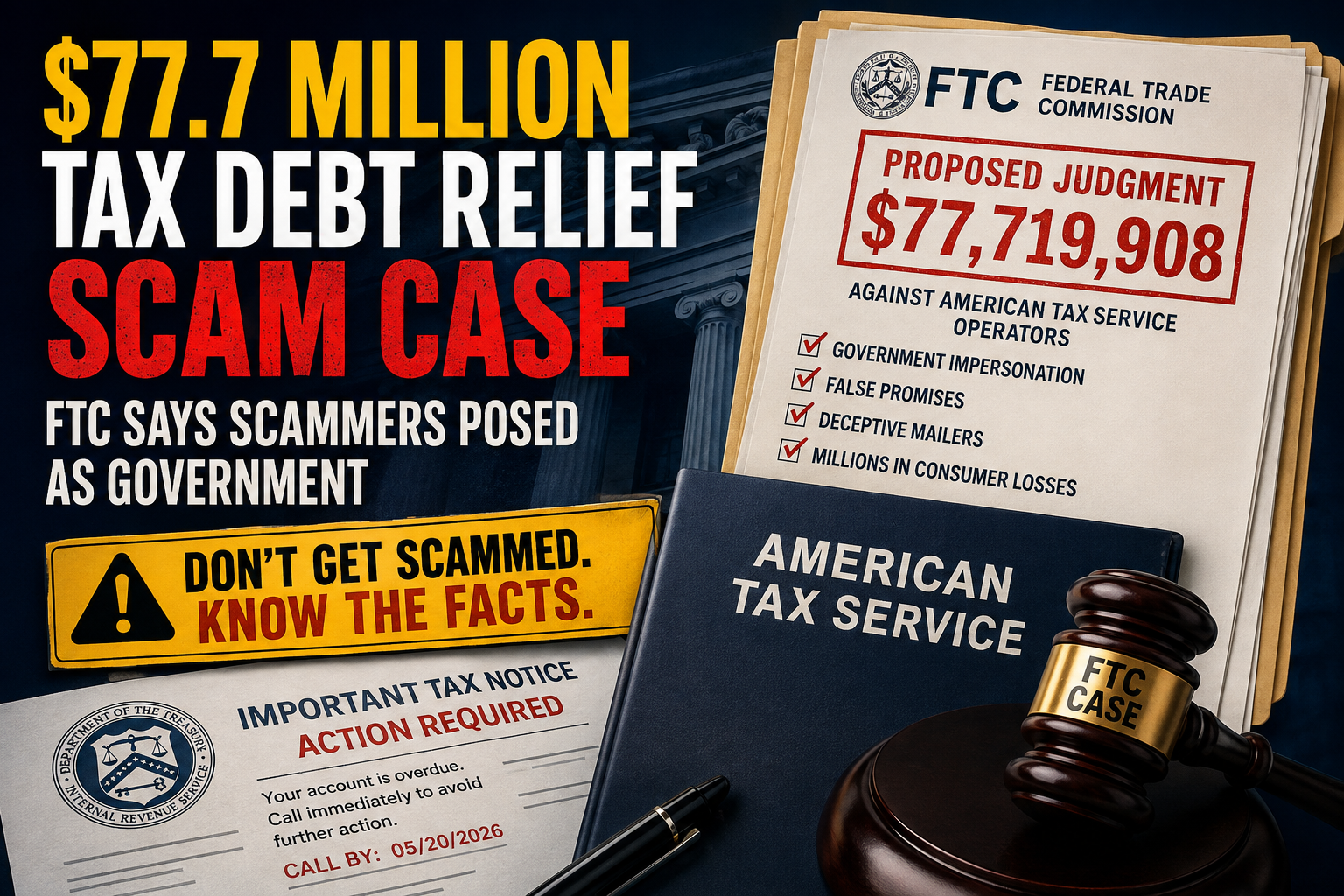
The tax debt relief scam case targets alleged government impersonation and false promises about settling back taxes. The FTC says consumers paid tens of millions, while refunds remain unannounced.
Key Facts
- Proposed judgment: The order would impose a $77,719,908 judgment against two American Tax Service operators.
- Required surrender: The package calls for about $8 million in cash, property, and a vehicle.
- Consumer warning: The case does not erase tax debts or guarantee payments to former customers.
What Happened in the Tax Debt Relief Scam Case
The Federal Trade Commission announced the proposed settlement with Nevada on June 2, 2026. It covers American Tax Service operators Terrance Selb and Tyler Bennett.
The proposed order sets a $77.7 million monetary judgment. The FTC says that amount reflects alleged consumer injury from February 2022 through 2025.
Required transfers would suspend most of the judgment. They include frozen cash, escrowed funds, real estate proceeds, and a vehicle.
The FTC alleges the operation sent mailers resembling government tax notices. Some demanded calls by a stated date and warned about property seizure.
Sales representatives allegedly promised “pennies on the dollar” before reviewing each taxpayer’s finances. Some allegedly claimed the IRS had flagged or investigated consumers.
The defendants neither admitted nor denied the complaint’s allegations, except jurisdictional facts. The FTC case page listed the broader matter as pending when checked.
What the $77.7 Million Figure Really Means
The headline judgment does not equal an immediate $77.7 million consumer refund. The proposed order requires roughly $7.98 million from frozen bank accounts.
It also requires a $309,262.35 escrow payment. A receiver would sell specified property and a 2022 Mercedes G63.
The proposal suspends the remaining judgment based on the defendants’ financial disclosures. A court could restore it after a material omission or misstatement.
Recovered money may support consumer redress and administration. The FTC has not announced eligibility, claim forms, payment amounts, or distribution dates.
That distinction matters for every tax debt relief scam victim. Recovery scammers may falsely promise government refunds for an upfront fee.
How to Spot a Tax Debt Relief Scam
A tax debt relief scam often starts with fear, urgency, or official-looking paperwork. Check these warning signs before sharing money or personal data.
- The sender demands a call before a short, unexplained deadline.
- A salesperson guarantees savings before reviewing income, expenses, assets, and tax records.
- The company claims the IRS marked your account “high risk” without verifiable documentation.
- The seller demands its full fee before completing meaningful service.
The FTC advises taxpayers to reject guaranteed settlement promises. Only the IRS or a state tax authority decides program eligibility.
What Legitimate IRS Tax Relief Looks Like
An IRS Offer in Compromise can settle qualifying tax debt below the full balance. It does not provide automatic “pennies on the dollar” relief.
The IRS reviews ability to pay, income, expenses, and asset equity.
Use the official IRS Offer in Compromise page to check requirements. You can also review an IRS online payment agreement.
Never trust a private company’s approval guarantee. A legitimate professional should explain fees, qualifications, risks, and expected work in writing.
Consumer-Safe Action Plan
- Stop before paying. Do not call a number solely because it appears on a threatening mailer.
- Verify the balance. Use your IRS Online Account or a verified IRS notice number.
- Preserve evidence. Save envelopes, contracts, invoices, emails, recordings, and payment records.
- Contact the payment provider. Ask quickly about charge disputes, transfer recalls, or fraud protections.
- Report it. Report the tax debt relief scam at ReportFraud.ftc.gov.
- Seek official help. Contact the Taxpayer Advocate Service for unresolved federal tax problems.
- Watch for refund imposters. The FTC does not charge consumers to receive an authorized refund.
Anyone affected by a tax debt relief scam should monitor official case updates. Do not pay a third party for refund access.
What Changes and What Does Not
- What changes: The proposed order would ban the individual defendants from debt relief and tax preparation services.
- What changes: It would also restrict telemarketing, impersonation, and material misrepresentations.
- What does not change: Taxpayers still owe valid federal, state, or local tax balances.
- What does not change: No announced refund program guarantees compensation to former ATS customers.
Questions That Remain Open
The FTC has not published a refund schedule or consumer claims process. The broader case page also lists the enforcement matter as pending.
Consumers should monitor official FTC updates rather than paid recovery services. This tax debt relief scam case may produce further filings or refund instructions.
How We Verified This Report
Fiscal Wire News reviewed FTC records, court filings, guidance, and IRS payment resources.
- Jurisdiction: United States
- Information checked: August 19, 2026
- Primary sources:
Editorial Review
Shailendra Singh wrote and reviewed this report against cited primary sources.
Important Information
This report provides general news and educational information. It is not personalized tax, financial, credit, or legal advice.
Official Source Stack
Direct sources supporting the material claims in this report.
- Official agency release Federal Trade Commission announced the proposed settlement
- Official agency release FTC case page
- Official agency release FTC advises taxpayers to reject guaranteed settlement promises
- Official agency release IRS Offer in Compromise page
This report provides general news and educational information for a U.S. audience. It is not individualized financial, credit, legal, tax, insurance or investment advice. Verify current procedures through the linked official sources.