Updated: August 23, 2026
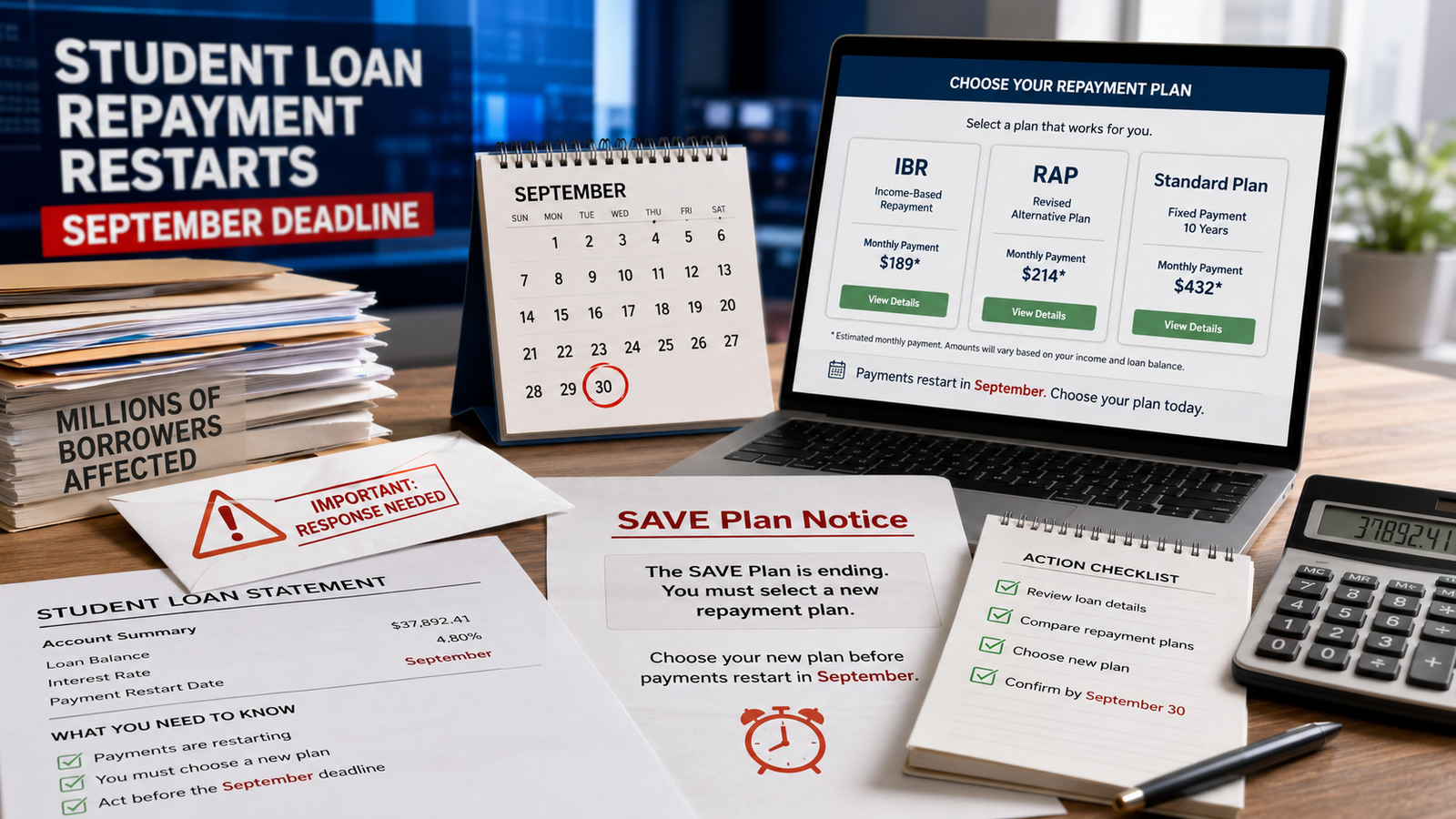
SAVE plan repayment is entering a new phase for millions of federal student loan borrowers. A March 10, 2026 court order ended the SAVE Plan, and affected borrowers are now being told to select another repayment plan. The key deadline is not one nationwide September date: borrowers generally have 90 days from the date of their servicer’s notice.
Key Facts
- The U.S. Department of Education said guidance would go to about 7.5 million borrowers who had enrolled in SAVE.
- A court order ended the SAVE Plan on March 10, 2026.
- Loan servicers are sending transition notices in waves, and affected borrowers generally receive 90 days from the date of their notice to choose another plan.
- If a SAVE borrower does not choose a plan, the servicer may place the borrower in either Standard Repayment or the new Tiered Standard Plan, depending on loan disbursement dates.
- Interest on loans in SAVE administrative forbearance began accruing again on August 1, 2025.
What the SAVE Plan Repayment Transition Means
The Department of Education announced on March 27 that borrowers enrolled in SAVE would need to leave the plan following a court-approved settlement that ended SAVE earlier that month.
The Department said about 7.5 million enrolled borrowers would receive guidance about moving to another federal repayment plan.
Borrowers can review the Department’s official SAVE transition announcement and current court-action information at StudentAid.gov court actions.
There Is Not One September Deadline for Every SAVE Borrower
The earlier idea that all SAVE borrowers face the same late-September cutoff is too broad.
Servicers are sending notices on different schedules. For example, Edfinancial says it is notifying affected SAVE borrowers between July 1 and August 15, while MOHELA says its notices are being sent in waves between July and October 2026.
Once the applicable notice is sent, the borrower generally has 90 days from that notice date to make a repayment-plan change.
That means one borrower may face a deadline in September while another may have until October, November, December, or later, depending on when the servicer sends the notice.
What Happens if You Do Nothing
Failing to choose a plan does not mean a borrower instantly defaults.
Current MOHELA guidance says borrowers already enrolled in SAVE may be automatically placed in either the Standard Repayment Plan or the new Tiered Standard Plan, depending on when their loans were disbursed.
Borrowers with a pending SAVE application may instead be moved back to the repayment plan they were using before submitting that application.
The practical risk comes later if required payments resume and the borrower then fails to make them. Missed required payments can eventually lead to delinquency, credit consequences, and, if unresolved long enough, default.
Your Repayment Options Have Changed
The federal repayment system changed again on July 1, 2026.
The Department introduced the new Repayment Assistance Plan (RAP) and Tiered Standard Plan. RAP bases monthly payments on income and dependents, while Tiered Standard uses repayment terms of 10, 15, 20, or 25 years based on total outstanding loan balance.
Eligibility depends on the borrower’s loan type, disbursement history, and other circumstances. Borrowers should not assume every repayment option is available to every loan.
The safest comparison tool is the federal StudentAid.gov Repayment Calculator, which can show available plans and estimated payments using the borrower’s actual federal loan information.
Interest Is Already Accruing on SAVE Forbearance Loans
Borrowers should distinguish the payment pause from interest accrual.
The Department announced in July 2025 that loans in the SAVE administrative forbearance would begin accruing interest on August 1, 2025. The Department said the interest would not be assessed retroactively for the earlier zero-interest period.
That means balances may continue growing while a borrower remains in SAVE forbearance, even before regular monthly payments resume.
A Separate September 30 Auto Pay Deadline
There is one September deadline that may cause confusion, but it is separate from the 90-day SAVE transition window.
Federal student loan servicers currently say the Auto Pay interest-rate reduction increased from 0.25 percentage point to 1 percentage point beginning July 1, 2026, for eligible Direct Loans disbursed on or after July 1, 2012.
Borrowers generally need to enroll by 11:59 p.m. Eastern Time on September 30, 2026 to receive the temporary 1% reduction through June 30, 2028.
That September 30 deadline concerns the temporary Auto Pay benefit. It is not the universal deadline for leaving SAVE.
What Borrowers Should Do Now
- Check your servicer notice. Find the date the SAVE transition notice was sent and calculate your individual 90-day period from that date.
- Confirm your contact information. Make sure StudentAid.gov and your loan servicer have your current email address and mailing address.
- Compare plans using federal tools. Review estimated monthly payments, repayment terms, and eligibility before selecting a replacement plan.
- Do not assume the lowest monthly payment is automatically the best option. Compare total repayment cost, interest treatment, forgiveness rules where applicable, and how long you expect to remain in repayment.
- Keep records. Save your notice, repayment-plan application, confirmation number, screenshots, and any communication with the servicer.
- Check your account after the change is processed. Moving into a new plan can end SAVE forbearance before the full 90-day window expires, so verify your new payment amount and due date.
What This Update Does Not Mean
The end of SAVE does not mean every affected borrower owes the same payment or has the same deadline.
It also does not mean borrowers who miss the plan-selection window immediately enter default. Servicers can place borrowers into another repayment structure, after which normal billing and delinquency rules apply.
Finally, the September 30 Auto Pay deadline should not be confused with the borrower-specific 90-day SAVE notice period.
Bottom Line
The SAVE Plan is over, but the repayment transition is individualized.
About 7.5 million borrowers were enrolled in the plan when the Department began transition guidance. Affected borrowers should focus on the date of their own servicer notice, compare the repayment plans actually available to their loans, and confirm the new payment before the SAVE forbearance ends.
The most important correction is simple: there is no single September repayment deadline for every SAVE borrower, and doing nothing does not automatically send every borrower into the same Standard Plan.
This article provides general news and educational information for a U.S. audience. It is not individualized financial, tax, legal, or student-loan advice. Federal repayment rules and servicing instructions can change; borrowers should confirm current information through StudentAid.gov and their official loan servicer.
Official Source Stack
Direct sources supporting the material claims in this report.
- Official agency release official SAVE transition announcement
- Court filing or order StudentAid.gov court actions
- Official agency release StudentAid.gov Repayment Calculator
This report provides general news and educational information for a U.S. audience. It is not individualized financial, credit, legal, tax, insurance or investment advice. Verify current procedures through the linked official sources.