Updated: August 20, 2026
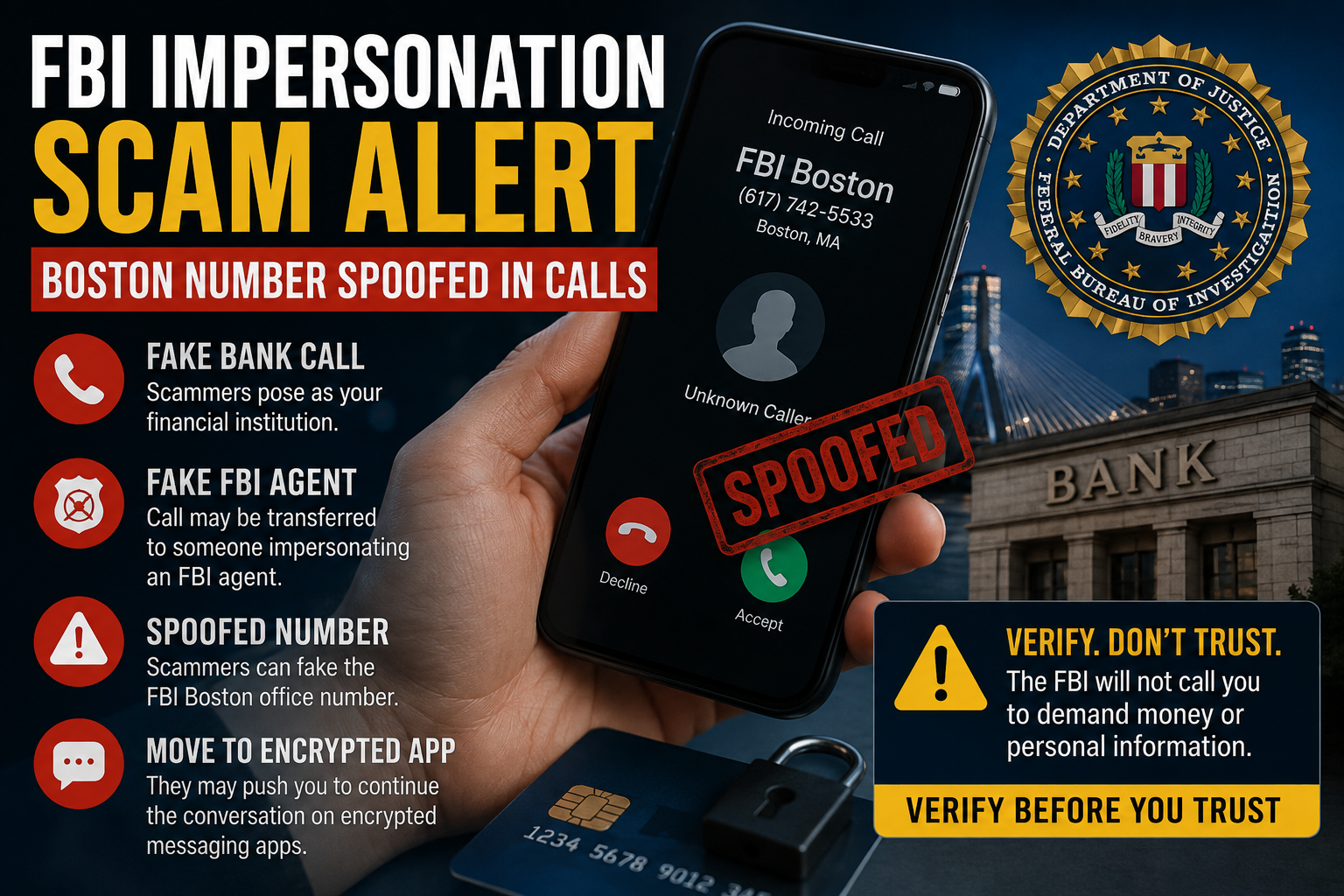
The FBI impersonation scam now flagged by the Bureau’s Boston Division can begin with a caller posing as a financial institution and then shift to someone claiming to be an FBI agent. The FBI says scammers can spoof the Boston office’s real phone number, so caller ID alone is not proof that a call is legitimate.
Key Facts
- FBI Boston’s press-release index dates the new warning August 17, 2026.
- The reported scam variant can start with someone claiming to represent a financial institution before another person poses as an FBI agent.
- Scammers may spoof the FBI Boston office number and try to move the conversation to an encrypted messaging application.
- The FBI says it will not call private citizens to demand payment, threaten arrest or request sensitive personal information.
- IC3 recorded 32,424 government-impersonation complaints in 2025, with reported losses of $797,943,193.
What Happened
The FBI’s Boston Division issued a warning about a new agent-impersonation scam affecting people in its territory, which covers Massachusetts, Maine, New Hampshire and Rhode Island.
According to the FBI Boston impersonation-scam warning, the scheme can begin with a caller claiming to be from a financial institution. The conversation can then be transferred to a person pretending to be an FBI agent.
The caller may use a fake name or badge number and spoof the FBI Boston office’s real telephone number. A displayed government number therefore does not establish that the person on the line works for the FBI.
How the FBI Impersonation Scam Works
The financial-institution angle matters because it gives the caller a plausible reason to discuss an account, suspicious activity or personal information. Similar FBI guidance on account-takeover fraud describes criminals posing as bank employees and, in some cases, handing victims to another scammer pretending to be law enforcement.
The FBI’s account-takeover fraud advisory warns that criminals may use calls, texts, emails and fraudulent websites to obtain login credentials, multifactor-authentication codes or other account information.
In the Boston warning, another red flag is a request to continue the conversation on an encrypted messaging app. Moving a conversation away from normal bank or government channels can make it harder for a victim to independently verify who is communicating with them.
What the Warning Does — and Does Not — Mean
The warning does not mean every unexpected call from a bank is fraudulent. Banks can contact customers about legitimate account issues. The safer test is whether you can independently verify the contact through a number or secure channel you already trust.
It also does not mean the FBI Boston phone number itself has been compromised. Caller ID can be spoofed, which means a scammer can make a legitimate number appear on a recipient’s screen without controlling that agency’s telephone system.
The new warning is a fraud-prevention alert, not an announcement that a particular bank has suffered a breach. The FBI has not identified a specific financial institution as responsible for the calls.
Why the National Loss Numbers Matter
The current Boston alert concerns a specific scam variant, but government impersonation is a much broader problem. The FBI’s 2025 Internet Crime Complaint Center report recorded 32,424 government-impersonation complaints and $797,943,193 in reported losses.
Those figures cover government-impersonation reports nationwide and should not be treated as losses from this Boston scam alone. They show the scale of the wider fraud category, not the financial impact of the newly reported variant.
What to Do if You Get One of These Calls
- End the call. Do not rely on the number displayed on caller ID, even if it matches an FBI office or your bank.
- Call your bank yourself. Use the number printed on your card, shown in the bank’s official app or listed on its verified website.
- Do not share security codes. Never provide passwords, one-time passcodes, Social Security numbers or banking credentials to an unsolicited caller.
- Do not move to another app on demand. Treat pressure to continue on an encrypted messaging platform as a reason to stop and verify the contact independently.
- Act quickly if money moved. Contact your financial institution immediately and ask what recovery or recall options may still be available.
- Preserve evidence. Save phone numbers, screenshots, messages, transaction records and any names or badge numbers the caller provided.
How to Report the Scam
People who believe they were targeted can file a report through the FBI Internet Crime Complaint Center. If money was transferred, report the incident promptly and provide transaction details.
Someone who wants to verify contact from FBI Boston can independently use the office information published by the FBI rather than calling back a number supplied during the suspicious conversation.
Bottom Line
The strongest defense against this FBI impersonation scam is independent verification. A familiar caller ID, official-sounding badge number or transfer from a supposed bank employee is not enough.
Hang up, contact the institution through a trusted number and never provide credentials or send money because an unsolicited caller claims law enforcement is involved.
This article provides general news and fraud-prevention information for a U.S. audience. It is not individualized legal, banking or cybersecurity advice. Fraud patterns can change, and suspected victims should use official bank and law-enforcement channels.
Official Source Stack
Direct sources supporting the material claims in this report.
- Official agency release FBI Boston impersonation-scam warning
- Official agency release account-takeover fraud advisory
- Official agency release FBI Internet Crime Complaint Center
This report provides general news and educational information for a U.S. audience. It is not individualized financial, credit, legal, tax, insurance or investment advice. Verify current procedures through the linked official sources.