Updated August 22, 2026
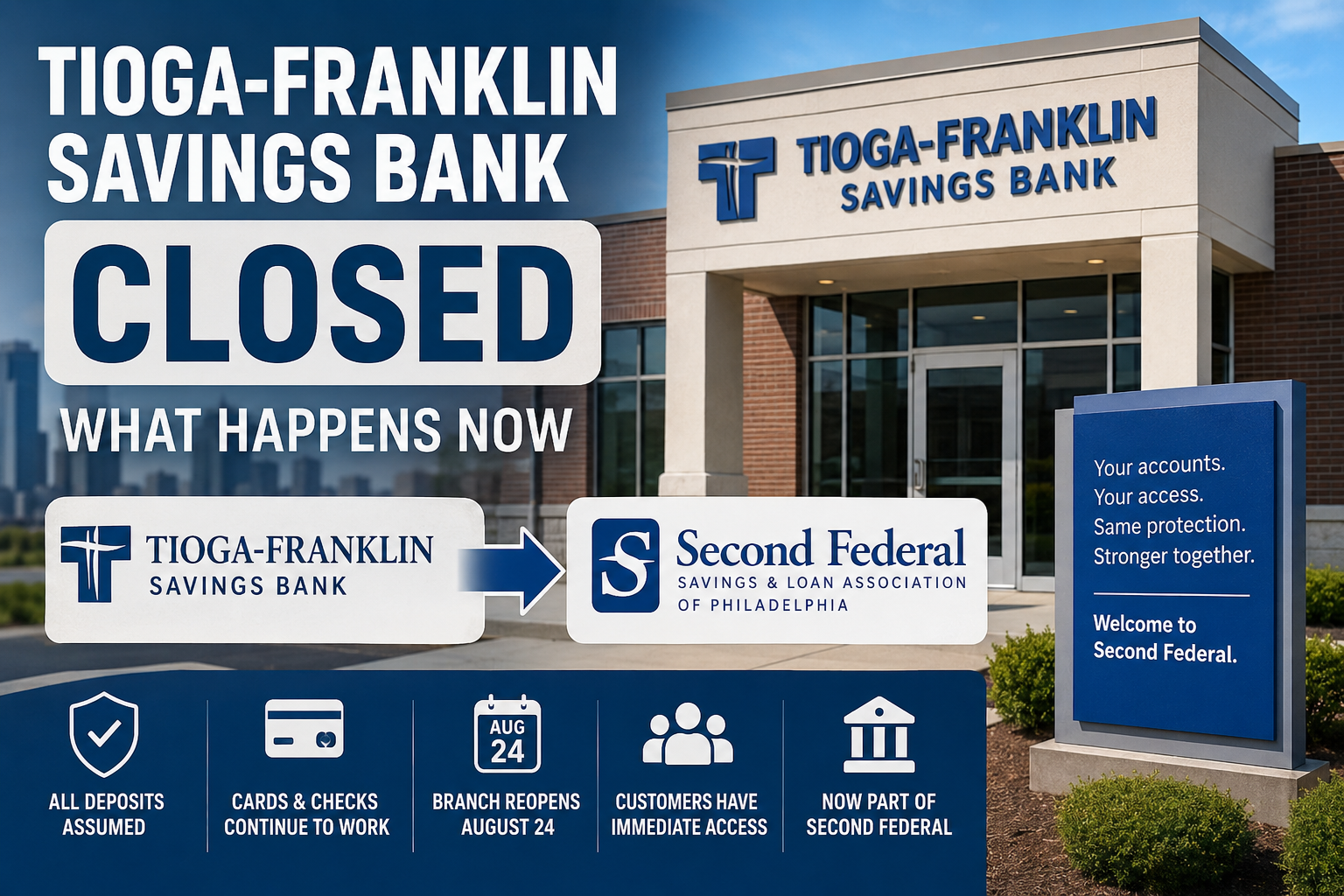
Tioga-Franklin Savings Bank was closed by Pennsylvania regulators on August 21, 2026, and the Federal Deposit Insurance Corporation was appointed receiver. For depositors, the immediate takeaway is straightforward: the FDIC says all deposits were assumed by Second Federal Savings & Loan Association of Philadelphia, customers have immediate access to their money, and the bank’s sole branch is scheduled to reopen under Second Federal on Monday, August 24.
- Pennsylvania regulators took possession of Tioga-Franklin Savings Bank on August 21, citing an unsafe and unsound condition.
- The FDIC says Second Federal assumed all deposits and purchased substantially all of the failed bank’s assets.
- Tioga-Franklin reported about $68 million in assets and $67 million in deposits as of June 30, 2026.
- Customers can continue using checks, ATM cards and debit cards; borrowers should keep making loan payments as usual.
- The sole branch is expected to reopen as a Second Federal branch on August 24.
What happened to Tioga-Franklin Savings Bank?
The Pennsylvania Department of Banking and Securities closure notice says the state took possession of the Philadelphia-based bank under state law, citing an unsafe and unsound condition, and appointed the FDIC as receiver. The department said the action was taken to protect depositors.
The FDIC’s August 21 resolution announcement says Second Federal assumed all deposits and agreed to purchase substantially all of Tioga-Franklin’s assets. The FDIC preliminarily estimates the failure will cost the Deposit Insurance Fund about $5.5 million. That is an estimated resolution cost to the insurance fund, not a reported loss to depositors.
What happens to Tioga-Franklin Savings Bank deposits?
According to the FDIC, Tioga-Franklin depositors automatically become depositors of Second Federal. Customers do not need to open a new account merely to retain access to the transferred deposits.
The FDIC says customers have immediate access to their funds. Checks written on Tioga-Franklin accounts will continue to be processed, and ATM and debit cards can still be used. The sole branch is scheduled to reopen on August 24 as a Second Federal branch during normal business hours.
There is an extra point for anyone who already had money at Second Federal. Under FDIC merger deposit-insurance rules, newly acquired deposits are generally insured separately from a customer’s pre-existing deposits at the acquiring bank for six months. CDs can receive different treatment depending on maturity and renewal terms. Large-balance customers should verify their specific coverage.
What did not change for customers?
The closure does not mean Tioga-Franklin customers automatically lost their deposits. Second Federal assumed all deposits, and the FDIC says the transferred deposits will continue to be insured.
Loan obligations also remain in place. The FDIC instructs borrowers to continue making payments as usual. Keep payment records and watch for formal instructions if payment addresses, online systems or servicing details change later.
What does the official record say about the closure?
The August 21 state notice gives the current public reason at a high level: regulators cited an unsafe and unsound condition. It does not identify one single event as the cause.
There is earlier regulatory history. An April 24, 2024 FDIC consent order addressed deficiencies and weaknesses involving board supervision, management, strategic and capital planning, liquidity and funds management, interest-rate risk, audit, credit administration and Bank Secrecy Act compliance. The bank consented to the order without admitting or denying the charges described in it.
That history provides context, but it does not prove that any particular item in the 2024 order caused the August 2026 closure. The newer state notice is the controlling source for what regulators publicly said when the bank was closed.
What Tioga-Franklin customers should do now
- Keep using your account normally unless official instructions change. The FDIC says checks, ATM cards and debit cards remain usable.
- Do not stop loan payments. Continue paying on schedule and save confirmation numbers or receipts.
- Review large combined balances. The FDIC deposit-insurance guide says the standard amount is $250,000 per depositor, per insured bank, for each ownership category.
- Be alert for impersonation attempts. Do not send account numbers, PINs or Social Security numbers in response to unsolicited messages.
- Use official FDIC information. The FDIC listed 1-866-314-1744 for Tioga-Franklin customers and maintains a dedicated Tioga-Franklin failed-bank page.
Bottom line
Tioga-Franklin Savings Bank is closed, but the resolution was structured to keep deposit access available. Second Federal assumed all deposits, the branch is scheduled to reopen August 24, and borrowers should continue making payments normally. Customers with large balances or accounts at both institutions should verify their individual FDIC coverage and watch for official notices from Second Federal or the FDIC.
Fiscal Wire News provides general consumer-finance information and does not provide individualized legal, banking, tax or investment advice. Deposit-insurance coverage depends on account ownership and other facts specific to each depositor.
Official Source Stack
Direct sources supporting the material claims in this report.
- Official agency release Pennsylvania Department of Banking and Securities closure notice
- Official agency release FDIC’s August 21 resolution announcement
- Official agency release FDIC merger deposit-insurance rules
- Official agency release April 24, 2024 FDIC consent order
This report provides general news and educational information for a U.S. audience. It is not individualized financial, credit, legal, tax, insurance or investment advice. Verify current procedures through the linked official sources.