Updated August 24, 2026
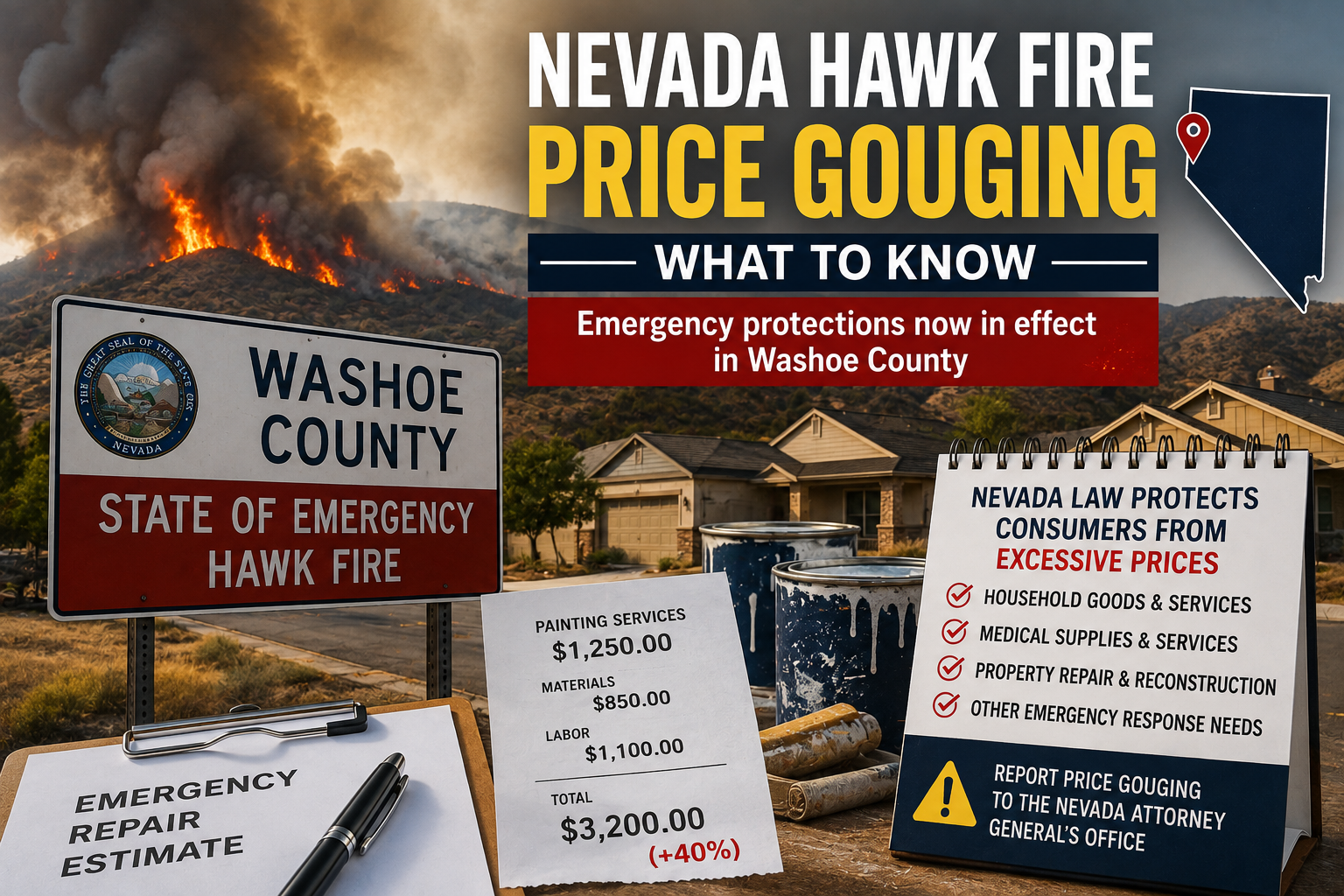
Nevada Hawk Fire price gouging protections are in effect in areas of Washoe County impacted by the wildfire after Gov. Joe Lombardo issued a formal state of emergency on August 23. Nevada law treats certain excessive emergency-area prices as deceptive trade practices, but the law does not make every price increase illegal.
Key Facts
- Nevada’s signed Hawk Fire declaration was issued August 23 and runs through August 29 unless terminated sooner.
- The emergency area is defined as areas impacted by the Hawk Fire in Washoe County.
- Covered categories include household consumer goods and services, medical supplies and services, property repair or reconstruction, and other emergency-response goods or services.
- Nevada law uses 15%, 10% and 5% price benchmarks depending on the transaction price, but prices above those levels are not automatically unlawful.
- Potential deceptive-trade-practice complaints can be filed with the Nevada Attorney General’s Office.
What Happened
Gov. Joe Lombardo announced a Washoe County state of emergency on August 22 as the Hawk Fire expanded. The Governor’s Office later attached a signed Hawk Fire Declaration of Emergency dated August 23.
The order says the emergency will continue through August 29 unless terminated sooner. It defines the emergency area as areas impacted by the Hawk Fire in Washoe County.
That geographic definition matters because Nevada’s emergency-pricing statute applies to covered sales, rentals and offers made in an emergency or disaster area while a qualifying declaration has been in effect for 75 days or less.
What Nevada Hawk Fire Price Gouging Rules Cover
Nevada Revised Statutes 598.09235 covers consumer goods and services used mainly for personal, family or household purposes; medical supplies and services; property repair or reconstruction services; and other goods or services commonly used in responding to the emergency.
A covered seller may commit a deceptive trade practice if it offers a covered item or service in the emergency area at a price that is grossly in excess of its usual price.
The comparison generally looks to prices in the emergency area during the 30 days before the declaration. The statute also addresses sale prices and cases in which a seller had not recently offered the item or service in that area.
The 15%, 10% and 5% Numbers Need Context
Nevada law identifies circumstances in which a price is not considered grossly in excess of its usual price.
- For goods or services priced at $250 or less, an increase of 15% or less falls within the statutory protection.
- For prices above $250 through $750, the figure is 10% or less.
- For prices above $750, the figure is 5% or less.
Those percentages are not automatic violation thresholds.
The statute says whether a price is grossly excessive is a legal question based on all relevant circumstances. It recognizes increased supplier, labor or material costs; certain pricing based on cost plus normal markup; market or seasonal fluctuations; and contract prices or pricing formulas established before the emergency.
A price above one of the percentage benchmarks may deserve closer review, but the percentage by itself does not prove unlawful price gouging.
Who Is Affected
The Hawk Fire protection is tied to the emergency area, not every transaction throughout Nevada. The declaration specifically identifies areas impacted by the fire in Washoe County.
The statute also excludes transactions occurring wholly outside Nevada and people who do not control the location or price at which the good or service is sold or rented.
No official source reviewed by Fiscal Wire alleges that any specific Washoe County business has violated the price-gouging law in connection with the Hawk Fire. This report explains the consumer protection now in effect; it is not an accusation against any seller.
What Residents Should Do Now
If a price appears unusually high during the emergency, preserve the evidence before assuming the transaction violates Nevada law.
- Save the price: Keep the advertisement, estimate, receipt or invoice.
- Record the details: Note the business name, location, date and time.
- Preserve online evidence: Take screenshots showing the price and seller.
- Look for earlier records: Keep older receipts or quotes showing what the same seller charged before the emergency, when available.
- Document repair costs: For property work, preserve written estimates and explanations of higher labor or material costs.
- Protect sensitive data: Do not post payment-card numbers, insurance policy numbers or other private financial information publicly.
Documentation matters because Nevada law expressly allows circumstances that can justify a price increase.
How to Report a Price-Gouging Concern
The Nevada Attorney General’s Office accepts formal consumer complaints through its official complaints and constituent FAQ page. The office says submitted complaints are reviewed and may be routed to the appropriate division or another agency.
The Nevada Bureau of Consumer Protection lists a consumer-protection hotline at 702-486-3132 and a toll-free number at 888-434-9989.
Filing a complaint does not guarantee a refund, enforcement action or finding that a business violated the law. The Attorney General’s Office reviews complaints and has enforcement authority under Nevada’s deceptive trade practices laws.
What Happens After August 29
The current Hawk Fire declaration runs through August 29 unless terminated sooner. If the governor extends or replaces the declaration, the timeline may change.
Nevada’s price-gouging statute applies during a qualifying state of emergency or disaster declaration that has been in effect for no more than 75 days. Residents should check official state updates before relying on August 29 if a new emergency order is issued.
Bottom Line
Nevada Hawk Fire price gouging protections apply in the Washoe County areas covered by the emergency declaration. The law gives residents a process to report potentially excessive emergency pricing, while also recognizing specific benchmarks and legitimate reasons prices may increase.
Keep receipts, screenshots and estimates, compare prices where possible, and use the Nevada Attorney General’s official complaint process if a transaction appears questionable.
This article provides general consumer news and legal information, not individualized legal advice. Whether a particular price violates Nevada law depends on the facts and applicable law.
Official Source Stack
Direct sources supporting the material claims in this report.
- Official agency release announced a Washoe County state of emergency
- Official agency release signed Hawk Fire Declaration of Emergency
- Official agency release official complaints and constituent FAQ page
- Official agency release Nevada Bureau of Consumer Protection
This report provides general news and educational information for a U.S. audience. It is not individualized financial, credit, legal, tax, insurance or investment advice. Verify current procedures through the linked official sources.