Published: August 20, 2026
Updated: September 17, 2026
Last fact-checked: September 17, 2026
Author: Shailendra Singh
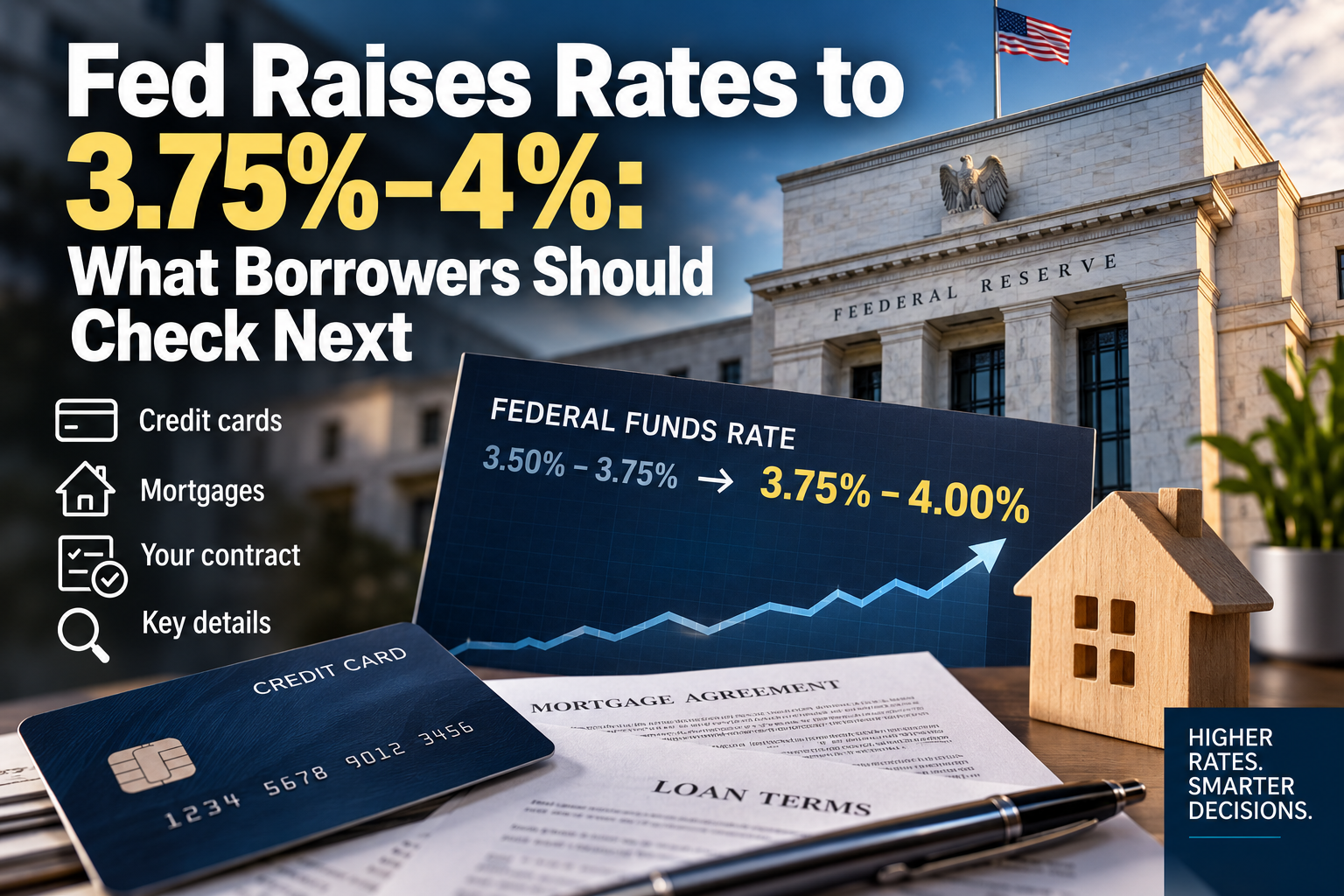
Current status: The Federal Open Market Committee raised the federal funds target range by 0.25 percentage point to 3.75%–4.00% on September 16, 2026. The Federal Reserve’s implementation instructions take effect September 17, 2026.
Correction history: On August 23, 2026, Fiscal Wire corrected an earlier version that overstated the July FOMC minutes as signaling an imminent rate increase. This September 17 update replaces the pre-meeting framing with the Federal Reserve’s actual September decision.
The Fed raises rates story is now an actual policy change, not a forecast. The Federal Open Market Committee voted 12–0 on September 16 to lift its target range by one-quarter percentage point. Borrowers with variable-rate credit cards or adjustable-rate mortgages may see costs change if their contracts use an index that moves higher, but the Fed decision does not automatically add 0.25 percentage point to every consumer APR or mortgage rate. Check your agreement, index, margin, reset date and any rate caps before assuming your payment changed.
Key Facts
- The federal funds target range increased from 3.50%–3.75% to 3.75%–4.00%.
- The September 16 FOMC decision was approved by a 12–0 vote.
- The implementation note makes the new operating range effective September 17, 2026.
- A variable credit-card APR changes according to the index and formula in the cardholder agreement.
- A fixed-rate mortgage does not change simply because the Fed raises its policy rate.
- The next scheduled FOMC meeting is October 27–28, 2026.
What the Fed changed on September 16
The September 16 FOMC statement says the Committee raised the target range for the federal funds rate by one-quarter percentage point to 3.75%–4.00%. That replaced the 3.50%–3.75% range maintained on July 29. The Fed said inflation remained elevated.
The separate implementation note says the new operating instructions take effect September 17. It also raises the interest rate paid on reserve balances to 3.90% and the primary credit rate to 4.00%.
Those are Federal Reserve policy and operating rates. They are not a universal consumer price list. Banks and lenders apply their own contract terms when setting card APRs, loan rates and mortgage pricing.
Fed raises rates: what to check on credit cards and mortgages
| Product | What controls your rate | What to check now |
|---|---|---|
| Variable-rate credit card | The agreement’s index plus its pricing formula or margin | Current APR, named index, adjustment timing and latest statement |
| Fixed-rate credit card | Not an automatic index adjustment | Any issuer notice changing terms and when that change applies |
| Fixed-rate mortgage | The rate set in the loan contract | No Fed-driven reset; review only if considering a new loan or refinance |
| Adjustable-rate mortgage | Index plus margin, subject to contractual caps | Next adjustment date, index, margin and initial, periodic and lifetime caps |
The CFPB explains that a variable credit-card APR moves with an index, while the cardholder agreement explains how the rate changes. For ARMs, the CFPB says the fully indexed rate generally combines the contractual index and margin, subject to applicable caps.
Illustrative cost of a 0.25 percentage-point APR increase
Hypothetical example: Assume a borrower’s actual APR rises by exactly 0.25 percentage point and the average interest-bearing balance stays constant. The simplified formula is: average balance × 0.0025.
| Average balance | Calculation | Approximate extra annual interest |
|---|---|---|
| $5,000 | $5,000 × 0.0025 | $12.50 |
| $10,000 | $10,000 × 0.0025 | $25.00 |
| $25,000 | $25,000 × 0.0025 | $62.50 |
This calculation does not establish an individual APR increase, bill, payment or loss. Credit-card interest is commonly calculated using daily balances, and actual costs depend on transactions, payments, compounding, grace periods and account terms.
What borrowers can safely do now
- Save the statement showing your current APR, balance, minimum payment and due date.
- Find the rate formula in your agreement. The CFPB maintains a credit card agreement database, but account-specific terms should be confirmed with the issuer.
- For an ARM, record the index, margin, next adjustment date and rate caps. Do not assume the federal funds rate is your mortgage index.
- If a rate change appears inconsistent with your contract, contact the lender and keep the date, representative name and written response.
- If the problem remains unresolved, the CFPB complaint portal accepts complaints about credit cards, mortgages and other consumer financial products.
What the Fed decision does not establish
The September action does not prove that every credit-card APR will rise by 0.25 percentage point, that existing fixed-rate mortgages will change, or that new mortgage quotes will move one-for-one with the federal funds rate. It also does not determine whether refinancing, balance transfers or early debt repayment are suitable for a particular household.
Borrowers carrying card balances may also want Fiscal Wire’s credit-card debt and APR report for broader context on balances and interest-bearing accounts.
What Fiscal Wire will update next
The Federal Reserve’s FOMC calendar lists the next scheduled meeting for October 27–28, 2026. Fiscal Wire should update this page if the FOMC changes the target range again, issues materially different implementation instructions, or new official consumer guidance changes the contract-based explanation above.
Bottom line
The Fed raised its target range to 3.75%–4.00%, effective through implementation beginning September 17. For borrowers, the safest response is not to assume an identical increase on every account. Check the contract that actually governs your APR or mortgage adjustment, document any change, and challenge a mismatch through the lender before escalating a complaint.
This article provides general financial-news and educational information for a U.S. audience. It is not individualized financial, credit, mortgage, legal or investment advice.
“`
Official Source Stack
Direct sources supporting the material claims in this report.
- Official agency release September 16 FOMC statement
- Official agency release 3.50%–3.75% range maintained on July 29
- Official agency release implementation note
- Official agency release variable credit-card APR moves with an index
This report provides general news and educational information for a U.S. audience. It is not individualized financial, credit, legal, tax, insurance or investment advice. Verify current procedures through the linked official sources.