Published: October 1, 2026
Last fact-checked: October 1, 2026
Current status: Effective October 1, 2026.
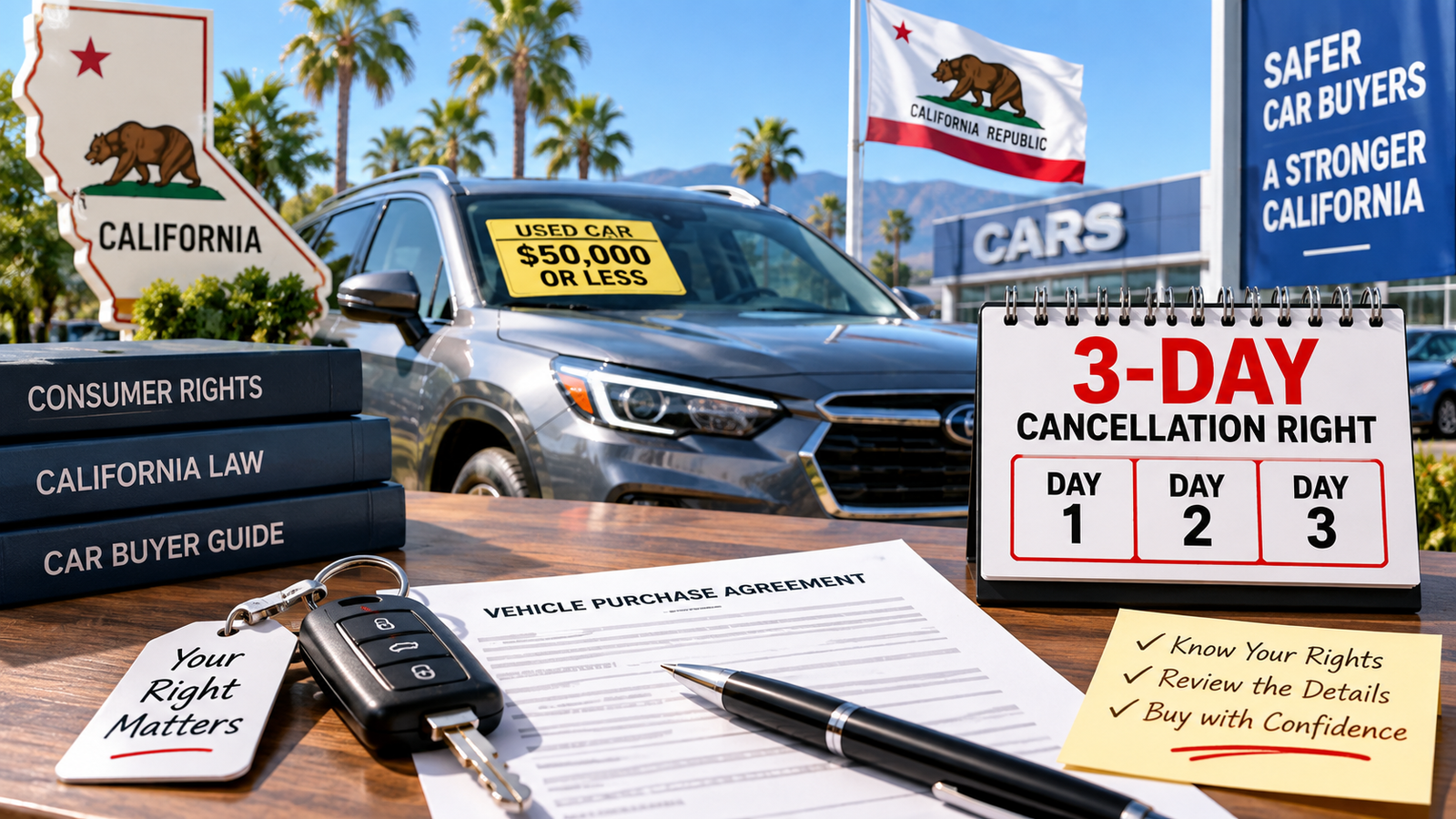
The California CARS Act is now in effect, changing how California dealers must advertise prices, discuss financing and add-ons, and handle certain used-car cancellations. The biggest new consumer right applies to a used vehicle sold or leased at retail for $50,000 or less: the buyer or lessee generally gets three days to cancel for any reason, subject to mileage, condition and return requirements. New vehicles do not get this three-day right.
Key Facts
- California Senate Bill 766 became operative on October 1, 2026.
- The three-day cancellation right applies to qualifying used vehicles priced at $50,000 or less.
- The period begins the calendar day after the purchase or lease is executed.
- The right is unavailable after the vehicle has been driven more than 400 miles.
- Dealers may charge a restocking fee generally equal to 1.5% of the sale price, with a $200 minimum and $600 maximum, plus a limited mileage charge after 250 miles.
What the California CARS Act changes
The California DMV’s CARS Act guidance says the law applies to licensed California dealers selling or leasing covered light-duty vehicles. It adds rules for total-price disclosures, financing representations and optional add-ons.
Under the chaptered text of Senate Bill 766, a dealer must disclose a vehicle’s total price in ads for a specific vehicle and in the first written communication mentioning that vehicle or financing terms. Written discussion of an add-on must disclose that it is optional.
The law also bars specified material misrepresentations about purchase, lease or financing costs, advertised availability, trade-ins, down payments and add-ons. Dealers cannot charge for certain add-ons that would provide no benefit.
Who gets the new 3-day cancellation right
| Situation | Three-day right? |
|---|---|
| Qualifying used vehicle priced at $50,000 or less | Yes, subject to conditions |
| Used vehicle priced above $50,000 | No under this provision |
| New vehicle | No |
| Motorcycle | No |
| Used vehicle driven more than 400 miles after signing | No |
The three-day period means three calendar days beginning the day after signing. If day three falls when the dealership is closed, it extends to the next open day and ends at close of business.
Source note: A separate DMV Car Buyer’s Bill of Rights page still shows some legacy two-day/$40,000 language. The dedicated CARS Act page and SB 766 reflect the October 1 operative law, so this report uses them.
How much could cancellation cost?
A dealer may charge a statutory restocking fee. The basic amount is 1.5% of the vehicle sale price, with a $200 minimum and $600 maximum. A dealer that charged shipping may use qualifying actual shipping cost instead, within the statutory limit.
Illustrative calculation: on a $30,000 qualifying used vehicle, 1.5% equals $450. If the buyer drove 300 miles, the law permits $1 for each mile above 250, adding $50. The illustrative total is $500. This assumes no alternative shipping-fee calculation and does not determine any individual buyer’s amount.
If the vehicle has been driven more than 400 miles, the statutory cancellation right does not apply.
How to use the cancellation right
The dealer must provide a separate disclosure titled “3-Day Right to Cancel Used Car Purchase or Lease.” To exercise the right, the buyer or lessee must return the vehicle to the selling or leasing dealer during business hours and meet the statutory conditions.
- Return the vehicle before the cancellation period expires.
- Keep mileage at or below 400 miles from signing to attempted cancellation.
- Return it free of new liens unrelated to the transaction.
- Return it in the same condition, allowing for reasonable wear and qualifying mechanical problems not caused by the buyer or lessee.
After a valid cancellation, the dealer generally must cancel the contract and provide the required refund within 48 hours, minus allowed deductions. A payment method such as a check can delay refund timing until the payment is verified.
What the law does not do
The California CARS Act does not create a universal cooling-off period for every vehicle purchase. It excludes new vehicles from this three-day right and also excludes categories including motorcycles, certain auction transactions, wholesale sales, qualifying fleet or commercial purchases, and vehicles with a gross vehicle weight rating of 10,000 pounds or more.
It also does not make every dealer add-on unlawful. An add-on can still be charged when selected by the consumer, lawful and beneficial.
What records buyers should keep
- The advertisement or online listing.
- The dealer’s first written price or financing communication.
- The purchase or lease agreement and financing documents.
- Add-on, GAP and service-contract paperwork.
- The separate cancellation disclosure and any cancellation receipt.
- Mileage photos or records.
Where to report a dealer problem
California DMV says complaints involving licensed vehicle dealers can be submitted through its DMV violations and complaints page. Filing a complaint does not guarantee a monetary award or a particular enforcement result.
What would require an update?
Fiscal Wire News should recheck this report if DMV issues revised implementation guidance, California amends SB 766’s operative provisions, or a court order changes enforcement or consumer rights under the law.
Bottom line
As of October 1, California car buyers have stronger price and add-on disclosure protections, while qualifying used-car buyers and lessees have a statutory three-day cancellation right. The $50,000 ceiling, calendar-day timing, 400-mile limit and return conditions matter. Anyone considering cancellation should use the required disclosure and act before the statutory period closes.
Editorial disclaimer: Fiscal Wire News provides general news and consumer information, not individualized legal or financial advice. Rights and remedies depend on the transaction facts and applicable law.
Official Source Stack
Direct sources supporting the material claims in this report.
- Official agency release California DMV's CARS Act guidance
- Regulation or statute chaptered text of Senate Bill 766
- Official agency release DMV Car Buyer's Bill of Rights page
- Official agency release DMV violations and complaints page
This report provides general news and educational information for a U.S. audience. It is not individualized financial, credit, legal, tax, insurance or investment advice. Verify current procedures through the linked official sources.