Updated
Update: An earlier version of this report said SB 492 remained in the Assembly Rules Committee. The official legislative history now shows that the bill was withdrawn from committee and ordered to third reading on August 30, 2026. It has not been signed into law.
The California wildfire fast-pay program proposed in SB 492 would create a structured claims process for certain future wildfires tied to eligible electrical infrastructure. The amended bill includes a 60-day documentation review and a 30-day settlement-offer period after a claim file is deemed sufficient. SB 492 is now ordered to third reading in the Assembly, but it remains proposed legislation. No statewide Fast-Pay claim portal or current payment right exists.
Key Facts
- The California Legislature published the amended wildfire text of SB 492 on August 29, 2026, at 7:26 a.m.; the bill text shows a revision dated August 30.
- On August 30, SB 492 was withdrawn from committee and ordered to third reading in the Assembly.
- The bill has not been signed into law, and the California Wildfire Relief Fast-Pay Program is not currently open.
- The proposed fast-pay administrator could establish advance payments of up to 20% of a claimant’s probable settlement offer, but such an advance would not be guaranteed.
- The bill would restrict certain transfers and financing of wildfire claims involving private-equity groups, subject to specified exceptions.
What Happened
Gov. Gavin Newsom announced a three-party wildfire compromise on August 29. His official statement on SB 492 described faster survivor payments, restrictions on hedge-fund involvement and additional utility-accountability measures.
The operative wildfire provisions appear in the official amended SB 492 bill text.
The bill’s status changed again on August 30. According to the California Legislature’s current SB 492 status page, the measure was withdrawn from committee and ordered to third reading in the Assembly.
That is a procedural advance, not enactment. The amended wildfire measure still must complete the remaining legislative process and receive the Governor’s approval before its proposed Fast-Pay provisions can become law.
How the California Wildfire Fast-Pay Program Would Start
The proposed program would not activate automatically after every wildfire.
SB 492 defines an eligible entity as an electric utility or public agency meeting specified wildfire-mitigation requirements. An eligible entity would provide notice that a wildfire is an “activating wildfire” under the conditions established in the bill.
The California Catastrophe Response Council would appoint a fast-pay administrator. If the bill takes effect, the administrator would have 180 days to establish procedures governing claims, documentation, settlement offers and releases.
For a particular activating wildfire, the administrator would begin accepting claims within 15 days after receiving the required activation notice.
The Proposed Claim Timeline
The headline timelines in SB 492 do not promise that a survivor would receive money within 60 or 90 days.
- Claim submission: A claimant would submit the claim and supporting documentation required by the Fast-Pay procedures.
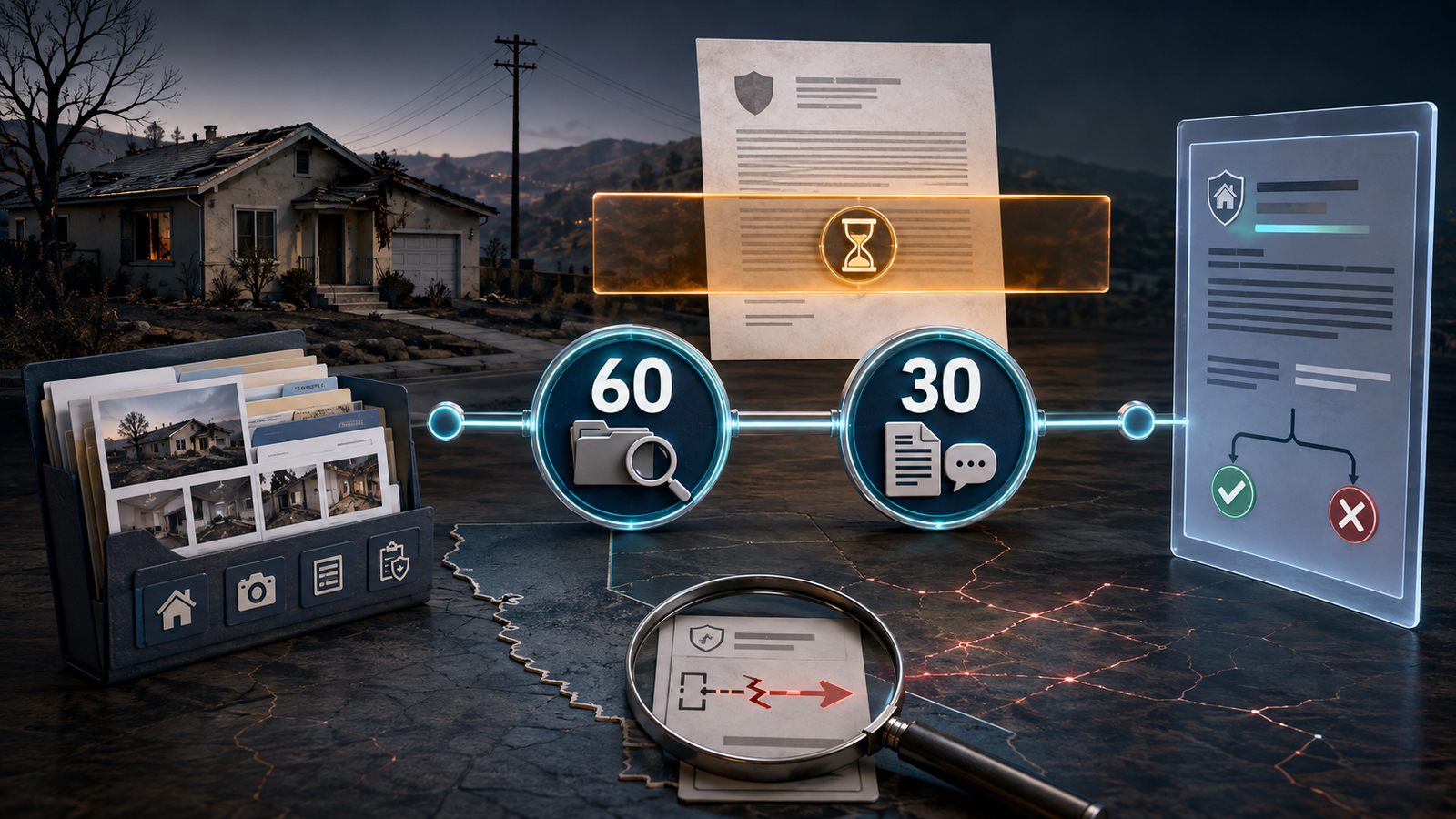
- Documentation review: Within 60 days after the required claim materials are submitted, the administrator would determine whether the documentation is sufficient.
- Additional records: If the file is insufficient, the administrator could request additional documentation and could ultimately decline to make an offer if the record remains insufficient after a reasonable opportunity to supplement it.
- Settlement offer: Within 30 days after determining that documentation is sufficient, the administrator would make a settlement offer.
- Claimant response: The claimant would have 30 days to accept or reject the offer. Failure to respond on time would be treated as rejection.
The bill also would permit the administrator to establish an advance-payment process. An advance could not exceed 20% of the claimant’s probable settlement offer based on a preliminary review.
Any accepted advance would be credited against a later Fast-Pay settlement, other settlement or judgment arising from the same wildfire.
Who Could File and What Losses Could Be Claimed
The program would apply only to claims arising from an activating wildfire under the statutory framework.
An individual claimant could seek compensation for qualifying damages, including specified real, personal or commercial property losses and noneconomic damages.
Subrogated insurers and public agencies would not fall within the same individual-claimant category.
Serious bodily injury, wrongful death, loss-of-consortium and certain bystander claims receive different treatment under the proposed administrative-presentment and litigation-stay provisions.
The bill also says a claimant would not need to establish utility causation merely to submit a Fast-Pay claim.
Insurance Would Still Matter
The proposed Fast-Pay system would not replace homeowners insurance or other available coverage.
Required claim materials would include information about available insurance, and recoveries from different sources could affect the final financial calculation.
Survivors should therefore continue reporting covered losses through existing insurance procedures rather than waiting for SB 492.
How the Program Could Affect a Lawsuit
SB 492 would preserve access to court, but certain claims that could be handled through Fast-Pay could be subject to a temporary litigation stay after discovery.
The bill generally provides that the stay could continue until 45 days after a completed administrative claim is submitted, unless the Fast-Pay administrator already denied the claim or the claimant rejected a settlement offer.
Different rules apply to bodily-injury, wrongful-death, loss-of-consortium and bystander claims.
Claimants would still need to monitor statutes of limitation, litigation deadlines and release language carefully.
What the Private-Equity Restrictions Actually Cover
Describing SB 492 as a blanket ban on all private-equity involvement would be too broad.
The amended bill generally would prohibit individuals and other entities from selling, assigning or transferring a wildfire claim, or a right of recovery on that claim, to a private-equity group.
It also would restrict transfers or collateralization of certain contingency-fee interests.
Private-equity groups would be prohibited from paying specified wildfire-claim expenses and from funding certain wildfire legal advertising for qualifying large fires.
The bill includes exceptions for specified family transfers, preexisting property interests, legal successors and certain bad-faith assignments.
Those provisions would not prohibit wildfire survivors from hiring attorneys.
What Has Not Changed
- SB 492 is not yet law. The bill being ordered to third reading does not itself create enforceable Fast-Pay rights.
- No Fast-Pay portal is open. Survivors cannot currently submit claims under the proposed chapter.
- No advance is guaranteed. The bill would authorize an advance process but would not promise every claimant a 20% payment.
- No settlement is guaranteed. A claimant’s documentation could be found insufficient, and an offer could be rejected.
- Existing insurance and legal deadlines still matter. The proposal does not suspend current obligations before enactment.
- The bill is prospective. The proposed Fast-Pay chapter would apply under the conditions and effective-date provisions stated in the final enacted law, if enacted.
What Wildfire Survivors Should Do Now
- Do not wait for SB 492. Report covered losses to insurers and follow existing claim deadlines.
- Preserve evidence. Keep photographs, inventories, receipts, repair estimates and communications with insurers or utilities.
- Track recovery sources separately. Record insurance payments, government assistance, utility compensation and other recoveries.
- Review contracts before signing. Understand legal fees, financing arrangements, assignments and release terms before transferring any claim-related rights.
- Monitor the official bill record. A third-reading order does not guarantee passage, and further legislative action could change the measure.
The California Department of Insurance maintains wildfire insurance resources for policyholders.
Consumers with unresolved insurance problems can also use the department’s consumer complaint and assistance service.
Bottom Line
The California Wildfire Relief Fast-Pay Program in SB 492 would create an expedited administrative route for some future utility-related wildfire claims while preserving defined court options.
The proposal includes a 60-day documentation-sufficiency review, a 30-day settlement-offer period after sufficiency is determined, and authority for advances of up to 20% of a probable settlement offer.
But the most important current fact is procedural: SB 492 was ordered to third reading in the California Assembly on August 30, 2026. It is not yet law, no Fast-Pay claim portal exists and no current consumer payment right has been created.
How We Verified This Report
Jurisdiction: California, United States
Last fact-checked: August 31, 2026
Primary Sources
- California Legislature — SB 492 official status and history
- California Legislature — SB 492 amended bill text
- Governor of California — August 29 statement on the SB 492 compromise
- California Department of Insurance — Wildfire Resources
Editorial Review
Written and reviewed against current primary sources by Shailendra Singh.
Important Information
This article provides general consumer information and is not legal, insurance or financial advice. Claim rights, deadlines and recovery options depend on final enacted law, the wildfire, available insurance and individual facts.
What this means in practical terms
People and businesses with qualifying future wildfire claims tied to eligible California electrical utilities or public agencies.
The proposal could permit an advance of up to 20% of a probable settlement; no advance is guaranteed.
SB 492 was withdrawn from committee and ordered to third reading in the California Assembly on August 30, 2026.
SB 492 is not yet law. No statewide Fast-Pay claim portal or current payment right exists.
Monitor the official California Legislature record and continue using existing insurance, legal and disaster-recovery processes unless the bill becomes law.
Official Source Stack
Direct sources supporting the material claims in this report.
- Official agency release official statement on SB 492
- Regulation or statute official amended SB 492 bill text
- Regulation or statute California Legislature's current SB 492 status page
- Official agency release wildfire insurance resources
This report provides general news and educational information for a U.S. audience. It is not individualized financial, credit, legal, tax, insurance or investment advice. Verify current procedures through the linked official sources.