Updated August 20, 2026
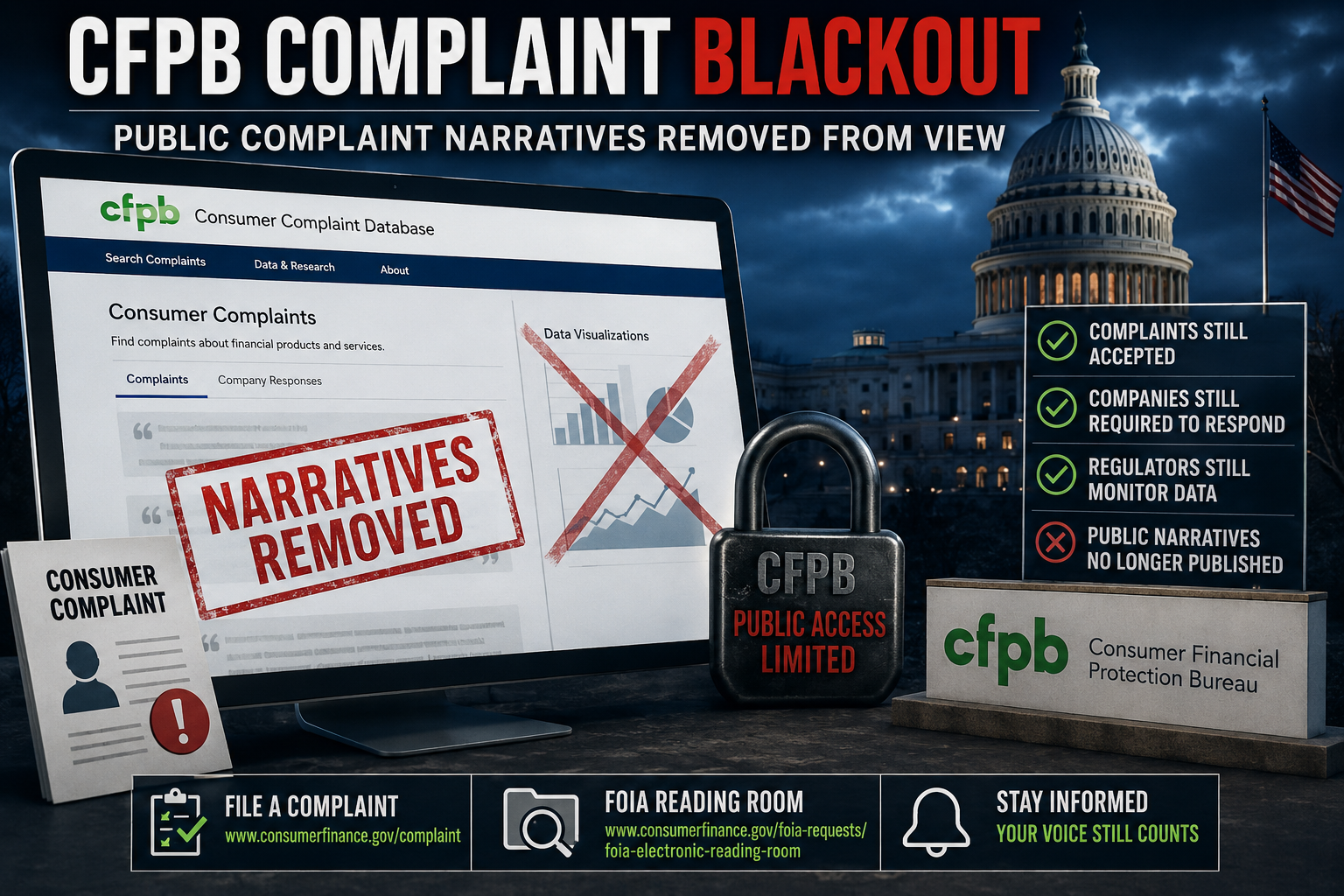
The CFPB complaint blackout changes how consumers can view certain complaint information online. The agency stopped publishing unverified complaint narratives and associated visualizations on August 14, 2026.
The change does not end the federal complaint process. Consumers can still submit complaints about covered financial products and services.
Key Facts
- The CFPB stopped discretionary publication of unverified complaint narratives and visualizations.
- The Bureau says those narratives can be one-sided, confusing, and potentially misleading.
- The CFPB will continue collecting, monitoring, and responding to consumer complaints.
- Previously published narratives are being proactively disclosed through the CFPB FOIA Reading Room.
- Consumers should still document disputes and file complaints when companies fail to resolve problems.
What the CFPB Complaint Blackout Actually Changes
The CFPB announced the policy change on August 14. It specifically addressed complaint narratives and related public visualizations.
The agency says complaint narratives present one consumer’s account of a dispute. The complaint process does not independently verify every allegation described in those narratives.
CFPB officials also said publication could create misleading impressions about a company’s legal compliance. The Bureau said the material could cause unnecessary reputational harm.
That distinction matters for readers following the CFPB complaint blackout. A submitted complaint is not automatically proof that a bank violated federal law.
What Is Not Being Shut Down
The federal complaint channel remains available. The CFPB says it will continue collecting, monitoring, and responding to consumer complaints.
The Bureau also reviews how companies respond to consumers. It can securely share complaint information with other federal and state regulators.
Consumers can still use the official CFPB complaint portal. The agency routes eligible complaints to financial companies for responses.
Companies generally respond within 15 days. Some cases may remain in progress before a final response arrives later.
Why the CFPB Complaint Blackout Matters to Consumers
Public narratives gave readers direct descriptions of disputed fees, account restrictions, servicing problems, and other reported experiences. Those stories also required context because they were unverified allegations.
The CFPB complaint blackout reduces easy access to that narrative layer. Consumers may have less qualitative information when researching recurring complaints about a company.
That does not make every company safer or riskier. Consumers should compare multiple evidence sources before opening accounts or borrowing money.
Review official disclosures, fee schedules, account agreements, and regulator actions. Do not treat anonymous reviews as verified findings of misconduct.
Where Previously Published Narratives Can Be Found
The CFPB says previously published narratives are considered public-domain material for FOIA purposes. The Bureau is proactively placing them in its FOIA Reading Room.
Readers can check the CFPB FOIA Reading Room before submitting a new records request. Existing disclosures may already contain the requested material.
This access method differs from browsing narratives directly beside database entries. Researchers may need more time to locate older records.
How to File a Strong Complaint After the CFPB Complaint Blackout
The CFPB complaint blackout does not remove your ability to seek a company response. A well-documented complaint can still move through the federal process.
- Contact the company first. Save emails, chat transcripts, letters, and reference numbers.
- Build a timeline. Record dates, disputed amounts, account actions, and promised resolutions.
- Attach useful evidence. Include statements, notices, screenshots, and relevant correspondence.
- Describe the requested resolution. State clearly what correction, refund, or explanation you want.
- Track the response. Review the company’s answer and preserve your complete case file.
Never publish account numbers, Social Security numbers, passwords, or other sensitive information. Provide private documents only through secure official channels.
When the FTC May Also Be Relevant
Some banking disputes involve scams, impersonation, identity theft, or deceptive business practices. Those issues may also warrant a Federal Trade Commission report.
The Federal Trade Commission directs consumers to official fraud and identity-theft reporting services. Filing a report does not guarantee enforcement or reimbursement.
What Consumers Should Do Now
Keep filing legitimate complaints when financial companies fail to resolve documented problems. The CFPB complaint blackout changes public visibility, not your ability to report an issue.
Use precise facts instead of accusations you cannot prove. Separate what happened from what you suspect may have happened.
Keep copies of every submission and company response. Those records can support later disputes with regulators, attorneys, or financial institutions.
For company research, use several sources. Check regulator actions, official disclosures, court records, and reliable reporting alongside consumer reviews.
Bottom Line
The CFPB complaint blackout is narrower than the phrase may suggest. The CFPB stopped publishing unverified narratives and associated visualizations, but complaint intake continues.
Consumers should still report documented financial problems through official channels. Strong records remain the best foundation for getting a clear response.
This article provides general consumer information and is not legal or financial advice.
