Updated August 24, 2026
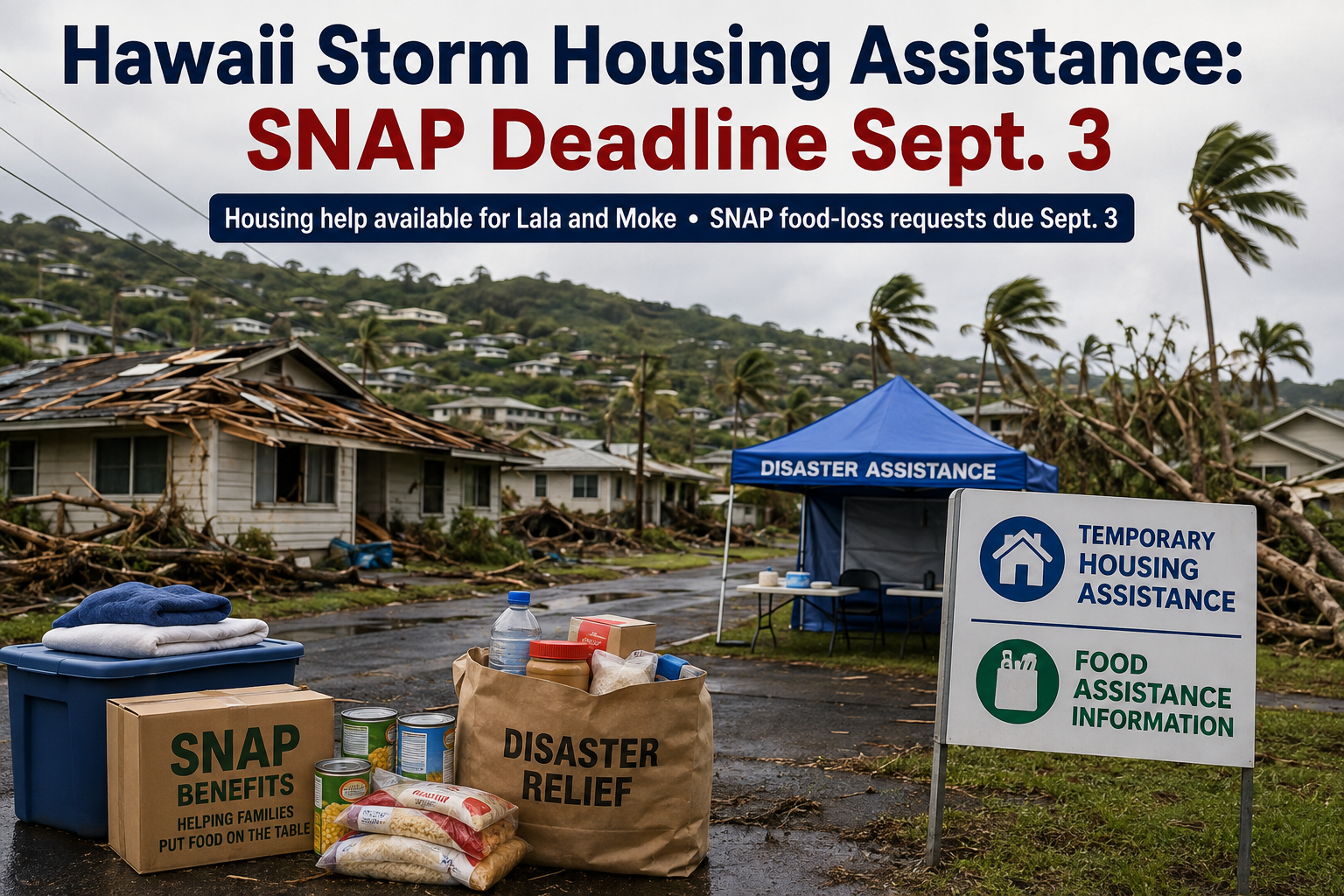
Hawaii storm housing assistance is available for residents affected by Tropical Cyclone Lala and Tropical Storm Moke, while current SNAP recipients who lost qualifying food because of Lala have until September 3 to request replacement benefits. The two forms of help are separate, and the state has published different instructions for each.
Key Facts
- Hawaiʻi officials said on August 23 that temporary housing assistance is available to residents impacted by Lala and Moke.
- The state assistance call center is open Monday through Sunday, 9 a.m. to 6 p.m., at 808-818-7587.
- Current SNAP recipients with qualifying food loss from Tropical Cyclone Lala have through September 3, 2026, to submit a replacement-benefit request.
- A SNAP replacement request requires a signed written statement with the participant’s name, date and estimated value of the food loss, what happened, and contact information.
- The state has not announced that every storm-affected household qualifies for housing help or SNAP replacement benefits.
What Happened
The Hawaiʻi Emergency Management Agency said in an August 23 storm response update that the Department of Human Services is providing temporary housing assistance to residents affected by Tropical Cyclone Lala and Tropical Storm Moke.
The same update said a call center is available seven days a week from 9 a.m. to 6 p.m. Residents seeking Hawaii storm housing assistance can call 808-818-7587, also presented by the state as 808-818-PLUS.
Separately, Hawaiʻi DHS had already announced on August 20 that the reporting deadline for certain SNAP food-loss replacement requests was extended statewide through September 3. The extension followed a state request for additional time after Lala-related outages, flooding and other household losses.
What the Official SNAP Guidance Actually Says
The Hawaiʻi DHS deadline notice applies to current SNAP recipients who experienced food loss tied to Tropical Cyclone Lala. The earlier SNAP replacement guidance says qualifying losses can include food destroyed after extended power outages of more than four hours or flooding.
Replacement benefits are based on the value of eligible food lost and cannot exceed the household’s total monthly SNAP benefit. A request is not an automatic payment. DHS says submissions are reviewed and validated before approved replacement benefits are issued.
To request a replacement, the household must submit a signed written statement listing the SNAP participant’s name, the specific date of the food loss, a specific estimated dollar value, a description of what happened and participant contact information.
Who Is Affected by Hawaii Storm Housing Assistance
The August 23 state update describes the housing help broadly as temporary assistance for residents impacted by Lala and Moke. However, the announcement does not publish a dollar cap, an income threshold, a guaranteed length of stay or a promise that every caller will receive placement.
That matters because Hawaii storm housing assistance should not be confused with a guaranteed cash benefit. Storm-displaced residents should call the official assistance line for screening and current availability rather than relying on social-media claims about eligibility.
What Changed — and What Did Not
The newest development is the state’s August 23 confirmation that temporary housing arrangements are available and that the assistance call center is operating daily. The September 3 SNAP deadline itself is older: DHS announced that extension on August 20.
The SNAP replacement program is also not the same as Disaster SNAP, or D-SNAP. The U.S. Department of Agriculture explains in its official disaster nutrition assistance factsheet that D-SNAP is a separate program requiring additional disaster and program approvals. The Hawaiʻi notices reviewed for this article concern replacement benefits for current SNAP recipients, not a newly announced D-SNAP application period.
As of the latest August 23 state update reviewed by Fiscal Wire, Governor Josh Green said Hawaiʻi had submitted a federal disaster declaration request. That update did not announce FEMA Individual Assistance or a new D-SNAP enrollment window.
What Residents Should Do Now
- For temporary housing: Call 808-818-7587 between 9 a.m. and 6 p.m., Monday through Sunday, and ask what documentation is required for the current housing-assistance process.
- For SNAP food loss: Prepare the signed written statement before September 3. Include the required specific loss date and estimated dollar value.
- Use an open DHS office: DHS says statements may be submitted to processing centers statewide, except the Kaʻū–Nāʻālehu and Kohala offices, which remain closed.
- Keep copies: Save the statement, supporting records and any confirmation information. Do not post EBT card numbers or other sensitive account information publicly.
- Verify before assuming eligibility: A statewide deadline does not mean every SNAP household automatically receives replacement benefits.
Official Help and Verification
For SNAP questions, Hawaiʻi DHS lists its Statewide Public Assistance Information Line at 1-855-643-1643. The state’s Tropical Storm Lala recovery page also maintains current housing, shelter, insurance and county assistance information.
Residents with property damage should preserve photos, receipts and repair records. Those records may be useful for insurance claims or later disaster-assistance applications even when they are not required for the SNAP replacement request.
Bottom Line
Hawaii storm housing assistance is active for residents affected by Lala and Moke, but the August 23 announcement does not promise housing to every applicant or publish a universal benefit amount. For current SNAP recipients with eligible Lala-related food loss, September 3 is the verified deadline to submit a signed replacement request.
This article provides general news and consumer information. Eligibility for public assistance depends on the applicable program rules and individual circumstances. Verify current requirements with the responsible government agency before submitting an application or relying on a deadline.
Official Source Stack
Direct sources supporting the material claims in this report.
- Official agency release August 23 storm response update
- Official agency release Hawaiʻi DHS deadline notice
- Official agency release SNAP replacement guidance
- Official agency release official disaster nutrition assistance factsheet
This report provides general news and educational information for a U.S. audience. It is not individualized financial, credit, legal, tax, insurance or investment advice. Verify current procedures through the linked official sources.