Updated August 20, 2026
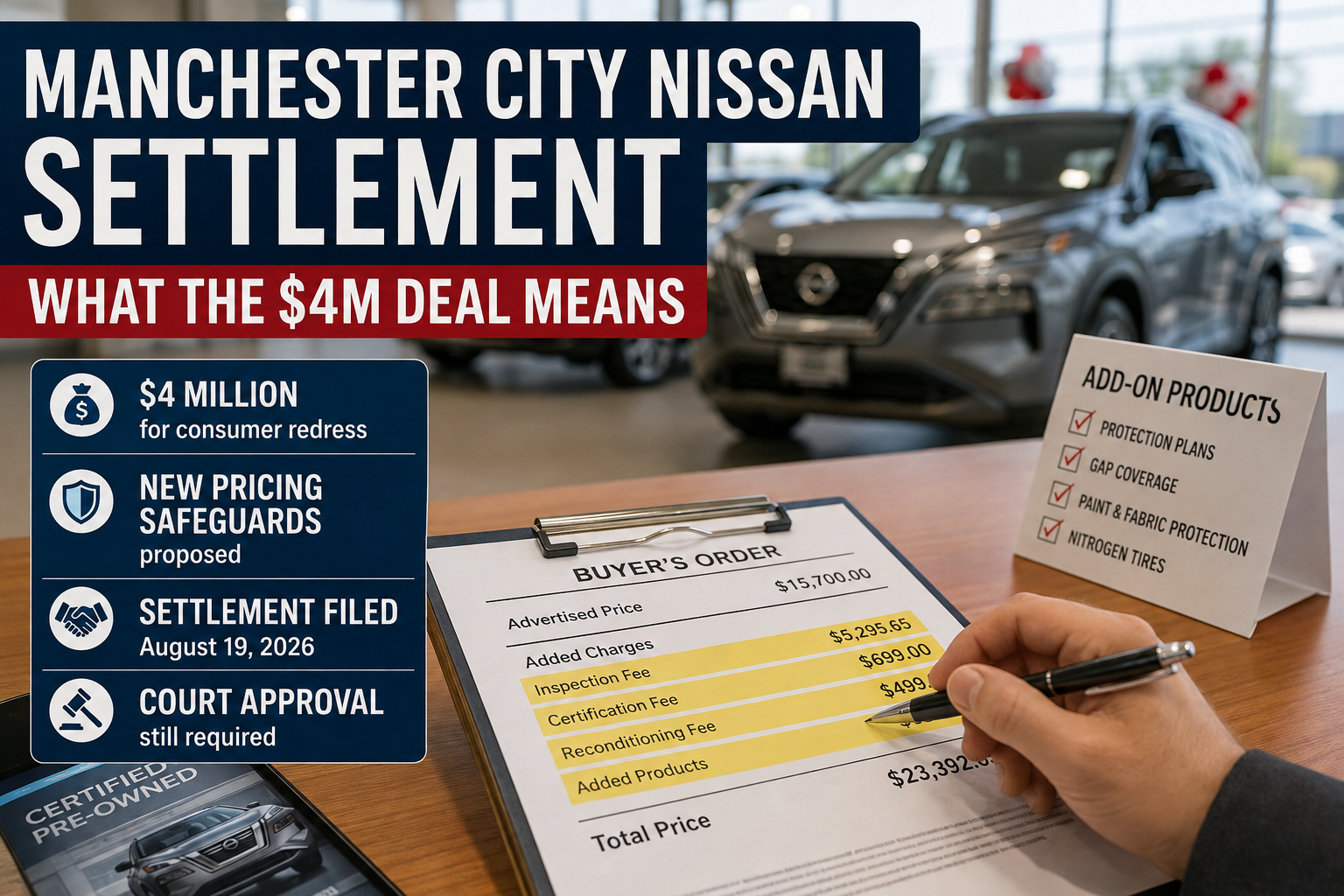
The Manchester City Nissan settlement announced on August 19 would require $4 million for consumer redress and new pricing safeguards if approved by a federal judge. The Federal Trade Commission and the State of Connecticut said the agreement resolves allegations involving certified pre-owned pricing, add-on products and other fees. The court has not yet given the stipulated final order the force of law, so consumers should not assume that a refund is already approved for them.
Key Facts
- The FTC and Connecticut announced the $4 million settlement on August 19, 2026.
- The proposed order directs the $4 million toward consumer redress.
- It would require prominent disclosure of the maximum total vehicle price, excluding required government charges.
- Defendants would also need express, informed consent before charging consumers for add-ons or other charges.
- The FTC says stipulated final orders take effect as law only after a district judge approves and signs them.
What Happened
The FTC and Connecticut sued Chase Nissan LLC, which did business as Manchester City Nissan, in January 2024. The case also named owners and managers. Regulators alleged deceptive and unfair practices involving advertised vehicle prices, certification fees, add-on products and government-related charges.
On August 19, 2026, the agencies announced the Manchester City Nissan settlement and filed a stipulated final order in the U.S. District Court for the District of Connecticut. The FTC Commission approved filing the order by a 2-0 vote.
The legal status matters. The FTC’s current case page lists the matter as pending, and its announcement says the proposed order becomes legally effective only when the district judge approves and signs it.
What the Official Record Actually Says
The agencies’ allegations are detailed in the amended federal complaint. Regulators alleged that some shoppers were charged extra certification, inspection or reconditioning fees after vehicles had already been advertised as certified pre-owned.
One example in the complaint involves a 2017 Nissan Rogue advertised for $15,700. Regulators alleged that the buyer was then charged a $5,295.65 inspection fee. The complaint also alleges that some add-on charges were inserted into financing paperwork without express informed consent. These are allegations in a civil case, not findings from a trial.
Under the proposed Manchester City Nissan settlement, defendants must pay $4 million for consumer redress. The order would also bar certain misrepresentations about certification and limited manufacturer warranties. It would require the maximum total price to be the most prominently displayed price, apart from required government charges.
Who May Be Affected
The direct consumer group is former Manchester City Nissan customers whose transactions may fall within the eventual redress process. As of August 20, the FTC announcement does not publish individual eligibility rules, a claims deadline, a payment schedule or a per-consumer refund amount.
That distinction is important. Buying or financing a vehicle from the dealership does not, by itself, establish that a person will receive money from the $4 million fund.
What the Manchester City Nissan Settlement Requires
If the court approves the order, the defendants would face continuing restrictions on how vehicle prices and charges are presented. They would have to obtain express, informed consent for charges and prominently disclose the maximum total price consumers must pay, excluding required government charges.
The Manchester City Nissan settlement does not create a new nationwide auto-pricing rule. It also does not automatically cancel a car loan, void an add-on agreement or guarantee a refund to every past customer.
What Consumers Should Do Now
Former customers who are concerned about their transaction can start by preserving their records. Keep the original advertisement, buyer’s order, retail installment contract or lease, add-on agreements, warranty documents, GAP or Total Loss Protection paperwork, payment records, emails and text messages.
Compare the advertised vehicle price with the final contract and identify each added charge. If an unfamiliar item appears, ask the dealer or relevant provider for a written explanation and keep the response. Because financed add-ons can become part of the amount financed, they can also affect the total borrowing cost depending on the loan’s APR and term.
Do not pay a third party that claims it can secure a settlement refund. Instead, monitor the official FTC case page for any redress instructions or eligibility notice.
Official Help and Complaint Resources
Readers can review the FTC’s August 19 Manchester City Nissan settlement announcement and the FTC Manchester City Nissan case docket and timeline.
Connecticut consumers can also review the Connecticut Attorney General’s settlement announcement and use the Connecticut Department of Consumer Protection complaint center for consumer-business disputes. Suspected fraud or deceptive practices may also be reported through the FTC ReportFraud portal.
Bottom Line
The Manchester City Nissan settlement is a significant consumer-redress agreement, but its procedural status should not be overlooked. The FTC and Connecticut have announced a $4 million settlement and filed a stipulated final order; the court must still approve and sign that order for it to have the force of law.
For former customers, the safest next step is to preserve transaction records and watch official government pages for refund instructions. No official individual payout formula or claims deadline was announced in the August 19 release.
Editorial disclaimer: This article provides general consumer-information reporting. It does not determine settlement eligibility, guarantee payment or provide legal advice.
Official Source Stack
Direct sources supporting the material claims in this report.
- Official agency release FTC's August 19 Manchester City Nissan settlement announcement
- Official agency release FTC Manchester City Nissan case docket and timeline
- Official agency release Connecticut Attorney General's settlement announcement
- Official agency release Connecticut Department of Consumer Protection complaint center
This report provides general news and educational information for a U.S. audience. It is not individualized financial, credit, legal, tax, insurance or investment advice. Verify current procedures through the linked official sources.