Updated
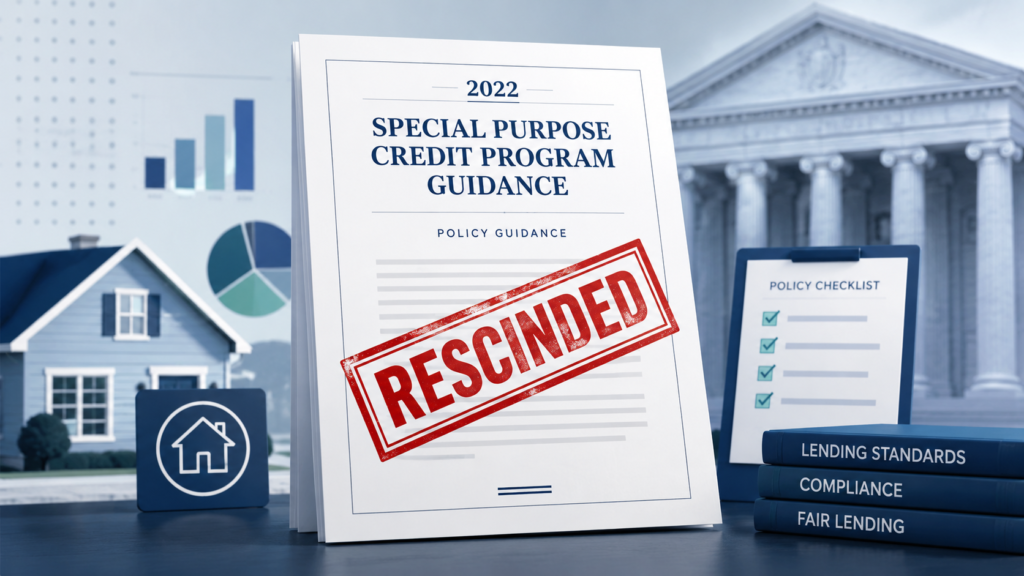
Federal agencies rescinded 2022 special purpose credit program guidance on August 25, directing creditors not to rely on the old interagency statement or related issuances. The notice does not abolish every special purpose credit program, create a consumer refund, or state that existing loans are canceled.
Key Facts
- Seven federal agencies published the rescission notice on August 25, 2026, and made it effective immediately.
- The Federal Reserve separately withdrew its related supervisory letter on August 21.
- Amended Regulation B had already taken effect on July 21, with tighter conditions for for-profit special purpose credit programs.
- Government-authorized, qualifying nonprofit and qualifying for-profit programs remain recognized under Regulation B.
- The agencies announced no refund, claims process or consumer filing deadline.
What Happened
The FDIC, NCUA, OCC, Consumer Financial Protection Bureau, Department of Housing and Urban Development, Justice Department and Federal Housing Finance Agency formally withdrew their 2022 interagency statement on special purpose credit programs. The August 25 Federal Register notice tells creditors not to rely on that statement or related guidance.
Special purpose credit programs, or SPCPs, are targeted credit programs permitted under the Equal Credit Opportunity Act and Regulation B when legal conditions are met. The rescinded special purpose credit program guidance had encouraged creditors to consider SPCPs for classes of people with identified credit needs.
The Federal Reserve participated in the original statement but is not one of the seven agencies listed on the August 25 notice. It had already withdrawn Consumer Affairs Letter 22-2 on August 21, citing the withdrawal of referenced guidance and changes to Regulation B.
Why the Special Purpose Credit Program Guidance Was Rescinded
The rescission is best understood as removal of guidance that no longer matches the regulatory framework, rather than a new rule. The CFPB issued final Regulation B amendments on April 22. They became effective July 21, 2026.
The agencies said the earlier statement relied partly on an earlier Regulation B text and interpretations that are no longer in effect. The notice directs creditors to the Equal Credit Opportunity Act, current Regulation B and, for housing credit, the Fair Housing Act.
The notice also states the agencies’ view that federal law does not authorize generalized remedial equity initiatives without specific cases of unlawful discrimination. That is an agency position in the notice, not a finding that every existing SPCP is unlawful.
Under the current special purpose credit program regulation, a for-profit SPCP may not use race, color, national origin or sex as an eligibility characteristic or factor. A qualifying for-profit program also needs a written plan identifying the intended class, its credit standards, evidence of need and why that class would not receive the credit without the program.
Who May Be Affected
The direct compliance burden falls on banks, credit unions, mortgage companies, fintech lenders and other creditors that offer or participate in targeted credit programs. Program sponsors may review eligibility standards, written plans, advertising and data.
Applicants could see a particular program revised, paused or replaced after a lender’s legal review.
What Changed—and What Did Not
What changed: The special purpose credit program guidance is no longer current federal guidance, and creditors should not rely on it. Credit extended through an SPCP on or after July 21 must meet the amended Regulation B standards.
What did not change: Regulation B still recognizes three broad categories: programs expressly authorized by federal or state law, qualifying nonprofit programs and qualifying for-profit programs. The rescission therefore is not a categorical ban on SPCPs.
The CFPB’s final rule also states that credit extended before July 21 is evaluated under the SPCP rule in place when the program was established and the credit was extended. That distinction helps explain why the August 25 notice should not be read as automatically invalidating every earlier loan.
No agency announced compensation, debt cancellation or a special claims portal. Any change to a borrower’s approval, rate, down-payment assistance or other terms should come from the creditor or program administrator in writing.
What Consumers Should Do Now
- Save the advertisement, eligibility terms, application, approval or denial notice, and all lender communications.
- Ask the lender in writing whether the program remains available and whether its standards changed after July 21 or August 25.
- Review any adverse-action notice carefully. Regulation B’s official interpretation says a creditor that rejects an applicant for failing SPCP eligibility requirements still must provide the notice required by Section 1002.9.
- Compare the lender’s standard products before assuming a program change makes you ineligible for other credit.
- Keep account numbers, Social Security numbers and application documents out of public posts or comments.
Official Complaint and Fair-Lending Resources
Someone who believes a lender handled an application improperly can use the CFPB consumer complaint portal. Include the key dates, terms, communications and supporting records. Submitting a complaint does not guarantee a particular result.
For alleged discrimination involving a mortgage or another housing-related transaction, HUD provides an official housing discrimination reporting service. HUD warns that filing time limits may apply, so affected borrowers should review the official instructions promptly.
Bottom Line
The special purpose credit program guidance rescission removes a 2022 statement that no longer aligns with amended Regulation B. It requires lenders to evaluate targeted programs under current law, but it does not eliminate every lawful SPCP. Borrowers should rely on written program terms, preserve records and use official channels when they believe a lender applied the rules incorrectly or unlawfully.
Editorial disclaimer: This article provides general consumer information and is not legal or financial advice. Program eligibility and legal rights depend on the facts, the creditor and applicable federal and state law.
“`
This report provides general news and educational information for a U.S. audience. It is not individualized financial, credit, legal, tax, insurance or investment advice. Verify current procedures through the linked official sources.