Updated August 22, 2026
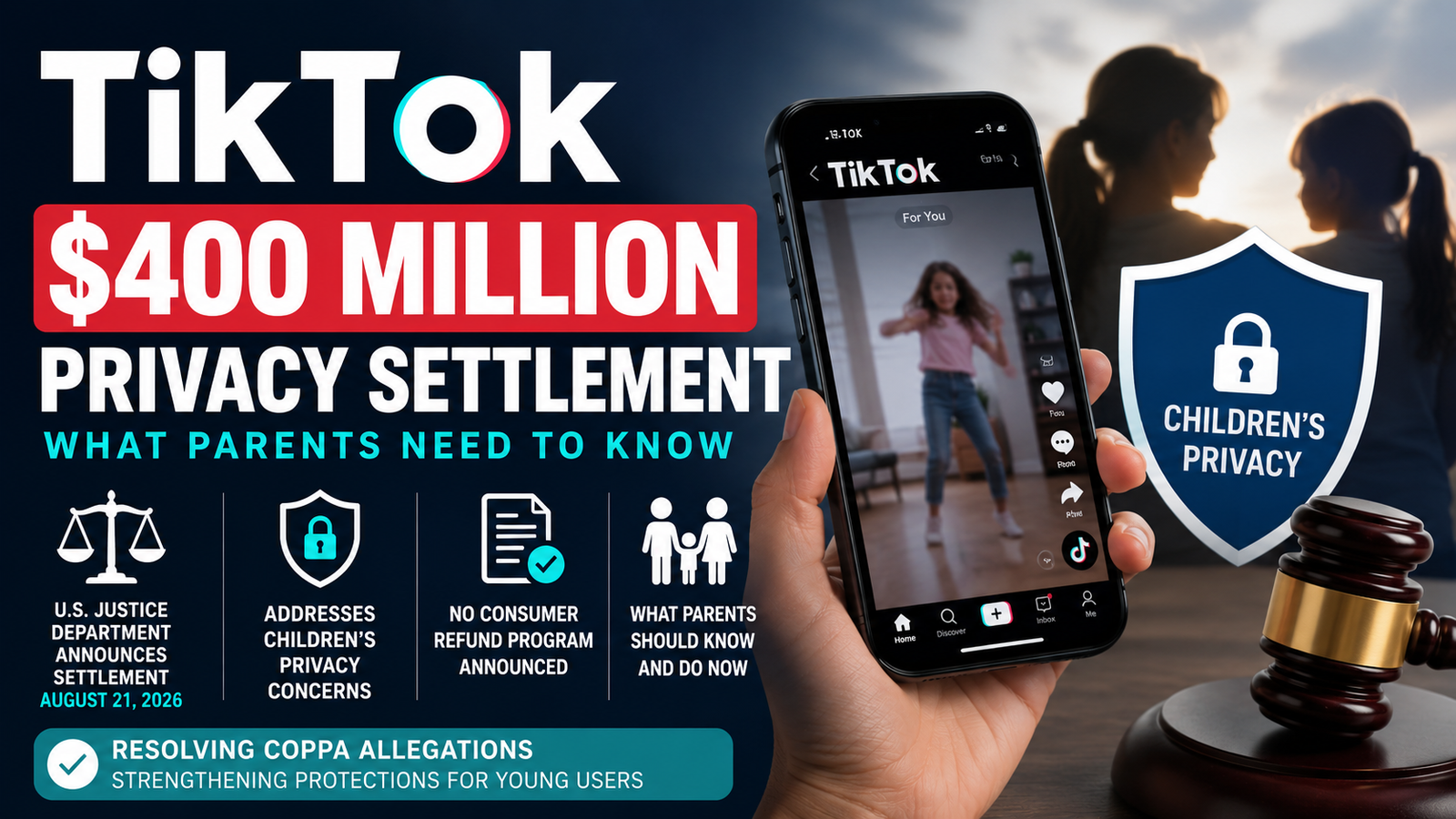
The TikTok $400M privacy settlement announced by the U.S. Department of Justice on August 21 resolves federal litigation involving alleged violations of children’s privacy law. It does not create a $400 million refund fund for parents or TikTok users. The DOJ says TikTok will pay $300 million immediately and another $100 million if a court enters an order vacating an older consent decree involving Musical.ly, TikTok’s predecessor.
- The Justice Department announced the TikTok $400M privacy settlement on August 21, 2026.
- TikTok will pay $300 million immediately; another $100 million is contingent on a court order vacating a prior Musical.ly consent decree.
- The case concerned alleged violations of the Children’s Online Privacy Protection Act, or COPPA.
- The DOJ says the resolved claims are allegations and there has been no determination of liability.
- No consumer refund program, claims deadline or individual payout was announced in the DOJ release.
What the TikTok $400M privacy settlement actually says
The Justice Department’s August 21 settlement announcement says TikTok, ByteDance and affiliated entities agreed to pay $400 million to resolve litigation involving compliance with COPPA and its implementing regulations.
The government filed the underlying lawsuit in the U.S. District Court for the Central District of California in August 2024 after a referral from the Federal Trade Commission. The FTC’s ByteDance case page identifies the matter as United States v. ByteDance Ltd., No. 2:24-cv-06535.
One timing detail matters. The DOJ says $300 million is payable immediately, while the remaining $100 million depends on entry of an order vacating a prior consent decree against Musical.ly. The full $400 million therefore should not be described as money already distributed to consumers or as a claims fund.
What did the government allege?
The 2024 complaint alleged that TikTok and ByteDance allowed children under 13 to create and use accounts without parental knowledge or consent, collected personal information from those users, and failed in some cases to honor parents’ requests to delete children’s accounts and data.
Those claims were allegations. The DOJ’s newer settlement notice expressly says there has been no determination of liability. Fiscal Wire News is therefore not treating the allegations as judicial findings.
The case also followed an earlier 2019 matter involving Musical.ly. In that case, the FTC announced a $5.7 million Musical.ly settlement over allegations that the service collected information from children without required parental consent. The new $100 million contingent payment is tied to a court order vacating that older consent decree.
What changed for parents and children?
The DOJ says TikTok has made significant changes since the 2024 lawsuit, including changes to ownership, management, compliance functions and privacy practices. It also says the company implemented measures designed to strengthen safeguards for younger users, improve age-related controls and increase parental oversight.
The public DOJ announcement does not provide a new consumer claims process or promise compensation to individual families. It also does not specify a payment date for parents because no parent-payment program was announced.
That distinction matters if settlement-related messages begin circulating online. A message claiming that every TikTok user or parent can collect part of the $400 million would not match the federal announcement as of August 22.
What rights do parents have under COPPA?
COPPA generally protects personal information collected online from children under 13. The FTC’s guidance for parents on children’s online privacy explains that covered services generally must obtain parental consent before collecting certain personal information from a child under 13.
The FTC also explains that parents can have rights to review information collected from their child, revoke consent and request deletion of the child’s personal information when COPPA applies. Those rights depend on the service and the circumstances; the TikTok settlement itself does not create a separate refund right.
What parents can do now
- Review your child’s account information. Check the age associated with the account and the privacy and parental-control settings currently in use.
- Review the service’s privacy notice. Pay attention to what information is collected, why it is collected and how deletion requests are handled.
- Save records of any privacy request. Keep screenshots, emails and confirmation numbers if you request account or data deletion.
- Do not pay anyone to claim settlement money. The DOJ has not announced a consumer refund process tied to this $400 million settlement.
- Report suspected privacy violations through official channels. Parents who believe an online service improperly collected or used a child’s information can use the FTC’s official ReportFraud portal.
What remains unanswered?
The Justice Department’s announcement does not identify individual consumers who would receive money, establish a claims deadline or describe a parent restitution program. It also leaves the final $100 million contingent on a separate court action involving the older Musical.ly consent decree.
As of August 22, the FTC’s public ByteDance case page still displays its older “Pending” status and an August 2, 2024 last-updated date. The Justice Department’s August 21, 2026 settlement announcement is the newer federal status update.
Bottom line
The TikTok $400M privacy settlement resolves federal children’s-privacy litigation without a determination of liability. For parents, the practical issue is not how to claim part of the $400 million; no such claims program was announced. The more useful step is to review children’s account and privacy settings, preserve records of any deletion request, and rely on DOJ and FTC pages for future updates rather than unofficial payout claims.
Fiscal Wire News provides general consumer information and does not provide legal advice. This article reflects publicly available federal information as of August 22, 2026.
Official Source Stack
Direct sources supporting the material claims in this report.
- Official agency release Justice Department’s August 21 settlement announcement
- Official agency release FTC’s ByteDance case page
- Official agency release FTC announced a $5.7 million Musical.ly settlement
- Official agency release FTC’s guidance for parents on children’s online privacy
This report provides general news and educational information for a U.S. audience. It is not individualized financial, credit, legal, tax, insurance or investment advice. Verify current procedures through the linked official sources.