Updated: August 21, 2026
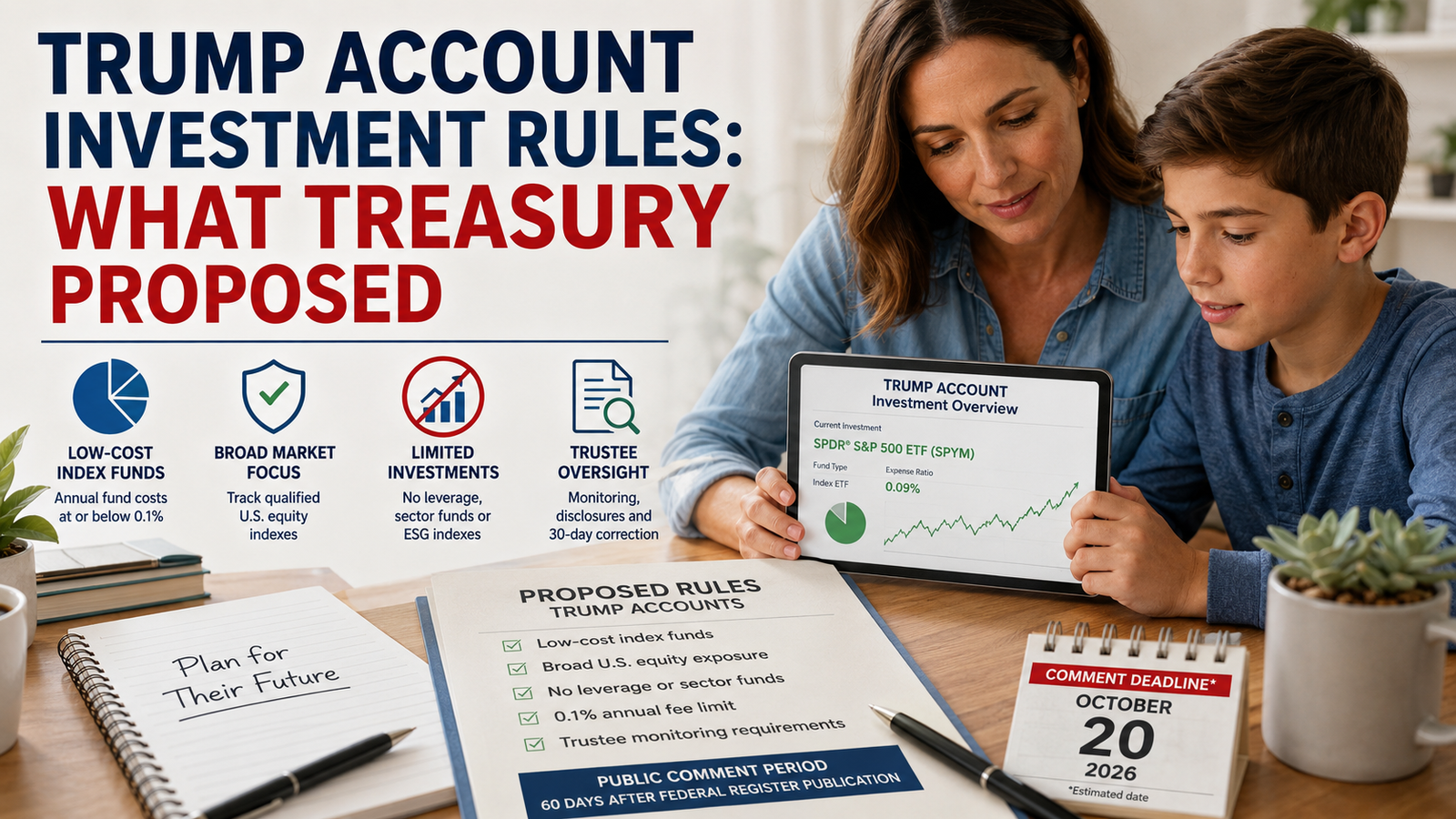
The proposed Trump Account investment rules would restrict children’s accounts to low-cost mutual funds and exchange-traded funds that follow broad equity indexes. Treasury announced the proposal on August 20, with Federal Register publication scheduled for August 21. The rules are not final, and families do not need to change investments because the proposal was released.
Key Facts
- Treasury and the IRS issued proposed regulations, not a final rule.
- Eligible funds would have to track a qualified equity index, avoid leverage and keep annual fund costs at or below 0.1%.
- Actively managed, sector-specific and ESG-index funds would be excluded.
- The 0.1% limit would not automatically cap separate trustee or administration fees.
What Happened
In an August 20 announcement, the Treasury Department described proposed standards for investments held during a Trump Account beneficiary’s “growth period.” That period ends on December 31 of the year the child turns 17. Most traditional IRA rules generally apply starting the following year.
The official Treasury and IRS proposal says eligible investments would be the only assets permitted during that period. The proposal affects beneficiaries and financial institutions serving as trustees or custodians.
The rules would generally apply to tax years beginning on or after January 1, 2026. Trustee operating procedures would begin after final regulations are published. Before then, taxpayers or trustees could rely on the proposal only by following it fully and consistently.
The public-inspection copy was scheduled for publication on August 21 and described the comment deadline as 60 days after publication. If publication occurs as scheduled, that period would end October 20, 2026. Anyone commenting should verify the date in the final Federal Register notice.
What the Trump Account Investment Rules Would Allow
An eligible investment would have to be a mutual fund or ETF that seeks to replicate a qualified index. A fund could use standard index-management practices, including holding fewer than every stock in the index. Actively managed funds seeking to outperform or behave differently from an index would not qualify.
A qualified index generally would need a public methodology and broad equity exposure. An index would receive a safe harbor as primarily U.S.-based when U.S. companies represent at least 90% of its weight. Industry, sector and ESG indexes would be excluded.
Leveraged funds also would be ineligible when borrowing, derivatives or similar strategies materially increase loss risk. Ordinary index-fund practices would not automatically count as leverage when they do not magnify that risk.
How the Proposal Relates to the Current Fund Lineup
Treasury announced an initial investment lineup on July 1. Its official investment announcement named the State Street SPDR Portfolio S&P 500 ETF, or SPYM, as the default.
Treasury also identified IVV, VTI, SPTM and ITOT as additional low-cost index ETFs. The proposed Trump Account investment rules set broader eligibility standards for funds and future trustees. They do not require families to sell the default fund or make a new election now.
What the 0.1% Fee Limit Does—and Does Not Cover
The proposed Trump Account investment rules would cap a fund’s combined annual fees and expenses at 0.1% of the invested balance. At that ceiling, fund-level costs equal about $10 a year for each $10,000 invested, before balance changes.
The proposal says separate trustee, custodial or intermediary charges are not part of that fund limit when the fund does not impose them. Treasury and the IRS are seeking comments on additional account-level protections, including whether trustees should be prohibited from charging certain fees.
Families should review both the fund expense ratio and any separate account charge. A low-cost fund does not necessarily make every account service free.
Trustees Would Face Monitoring Duties
A trustee would have to offer only funds it determined were eligible. Each account would need a disclosed default investment and an explanation of how dividends will be reinvested.
A trustee could use a monitoring safe harbor by checking fund eligibility at least once every 12 months. An ineligible fund generally would have to be sold and replaced within 30 days, followed by notice to the beneficiary.
Who Is Affected
Trump Accounts can generally be established for eligible people under 18 with Social Security numbers. The separate $1,000 Treasury pilot contribution is limited to qualifying U.S.-citizen children born from 2025 through 2028 and requires an election. The investment proposal does not expand that eligibility.
What Families Should Do Now
- Do not change investments solely because a proposal was issued.
- Review the current holding, fund expense ratio and separate service fees.
- Use the official Trump Accounts portal, not links in unsolicited messages.
- Save statements and notices describing investments, fees and automatic changes.
- Remember that broad-market funds can lose value. Low costs do not guarantee gains.
- Watch the final Federal Register notice for the comment deadline and later updates.
The SEC’s Investor.gov Trump Account overview explains the account structure and investment limits.
Bottom Line
The proposed Trump Account investment rules would formalize a low-cost, broad-index approach and impose monitoring duties on trustees. They would not guarantee returns, expand the $1,000 pilot program or require an immediate investment switch. Families should monitor the final notice and review both fund expenses and separate account charges.
Editorial disclaimer: This article provides general consumer information and is not tax, legal or individualized investment advice. Proposed regulations may change before finalization.
Official Source Stack
Direct sources supporting the material claims in this report.
- Official agency release August 20 announcement
- Regulation or statute official Treasury and IRS proposal
- Official agency release official investment announcement
- Official agency release the official Trump Accounts portal
This report provides general news and educational information for a U.S. audience. It is not individualized financial, credit, legal, tax, insurance or investment advice. Verify current procedures through the linked official sources.