Updated
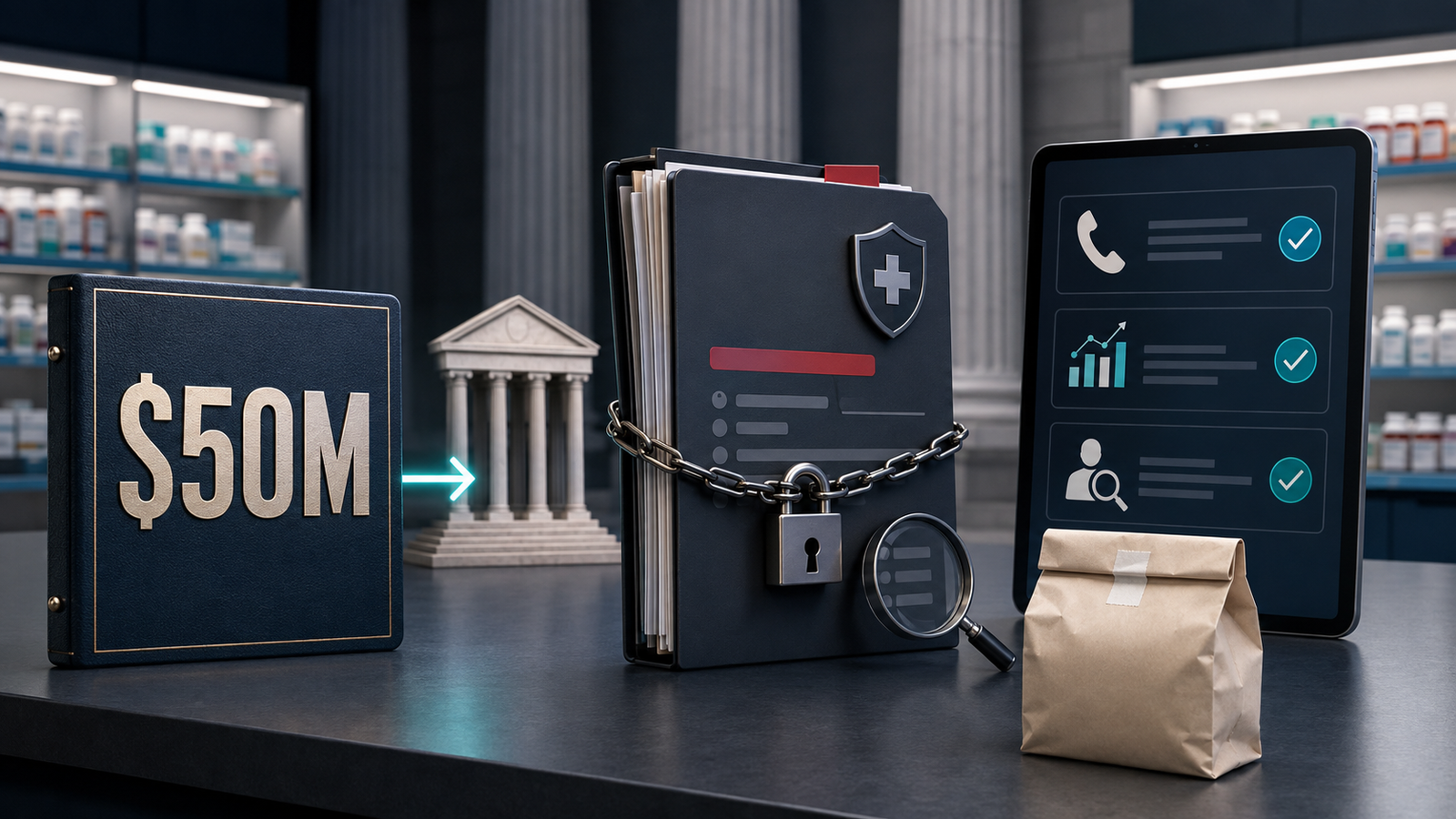
The Walmart opioid settlement requires Walmart Inc. to pay $50 million and accept new Drug Enforcement Administration compliance obligations. The August 28, 2026 agreement resolves federal allegations that Walmart pharmacies filled thousands of invalid prescriptions for opioids and other controlled substances. The settlement includes no determination of liability and does not create a consumer refund program.
Key Facts
- The Justice Department and DEA announced the $50 million Walmart opioid settlement on August 28, 2026.
- The underlying federal complaint was filed on December 22, 2020 and amended in 2022.
- The government alleged that Walmart pharmacies filled thousands of invalid prescriptions for opioids and other controlled substances.
- Walmart agreed to establish a reporting hotline, monitor pharmacy dispensing patterns and evaluate prescribers suspected of illegal prescribing.
- The resolved claims remain allegations. DOJ says there was no determination of liability.
- No patient refund fund, individual claim form or consumer payment deadline was announced.
What Happened in the Walmart Opioid Settlement
The Justice Department and Drug Enforcement Administration announced the agreement on August 28, 2026.
The official federal announcement says Walmart agreed to pay $50 million to resolve allegations that its pharmacies illegally filled thousands of invalid prescriptions for opioids and other controlled substances in violation of the Controlled Substances Act.
The underlying government complaint was filed on December 22, 2020 in the U.S. District Court for the District of Delaware and was amended in 2022.
According to DOJ, the settlement addresses alleged past conduct while also imposing forward-looking pharmacy compliance obligations through a memorandum of agreement with DEA.
The government also states that the claims resolved by the agreement are allegations only and that there has been no determination of liability.
What Federal Officials Alleged
The amended federal allegations concern conduct dating back to June 26, 2013.
DOJ alleged that members of Walmart’s compliance team knew that certain prescribers were operating as so-called “pill mills,” while prescriptions from those prescribers continued to be filled.
Federal officials said Walmart pharmacists had submitted thousands of refusal-to-fill reports containing concerns about suspicious prescribers and prescriptions.
The government alleged that Walmart’s corporate compliance operation failed to adequately analyze or act on some of those warnings.
DOJ also alleged that individual pharmacists sometimes filled prescriptions despite red flags suggesting that the prescriptions were invalid.
Examples described by federal officials included dangerous drug combinations, repeatedly high doses of frequently abused opioids and repeated requests for early controlled-substance refills.
These allegations were resolved through settlement rather than adjudicated through a trial establishing Walmart’s liability.
What the Walmart Opioid Settlement Requires
The agreement contains both a monetary component and new compliance obligations.
$50 Million Federal Payment
Walmart agreed to pay $50 million to the federal government.
The DOJ and DEA announcements do not identify that payment as a consumer compensation fund.
Consumers therefore should not interpret the headline $50 million figure as money that will automatically be distributed to former or current Walmart pharmacy patients.
Employee and Patient Reporting Hotline
The DEA memorandum of agreement requires Walmart to establish a hotline that employees and patients can use to report suspected illegal dispensing of controlled substances.
The federal announcements reviewed for this report do not provide a public hotline number or detailed consumer claims procedure tied to the settlement.
Consumers should therefore verify any future hotline through Walmart or DEA rather than relying on unsolicited texts, emails or social-media posts.
Pharmacy Dispensing Monitoring
Walmart also must proactively monitor dispensing patterns at its pharmacies to identify and address potentially illegal controlled-substance dispensing.
This creates a broader compliance mechanism rather than relying solely on complaints about individual prescriptions.
Review of Suspect Prescribers
The agreement requires Walmart to establish a process for evaluating prescribers suspected of illegal prescribing.
The public announcement does not mean that every prescription from a reviewed prescriber is automatically invalid.
Does the $50 Million Go to Patients?
No consumer refund program was announced with the Walmart opioid settlement.
The federal releases do not provide:
- a consumer settlement claim form;
- a patient eligibility list;
- a refund amount;
- a consumer payment schedule; or
- a claims deadline.
A message claiming that a patient must provide a Social Security number, bank information or an upfront fee to receive part of the $50 million should therefore be independently verified before any information is provided.
What the Settlement Does Not Establish
The settlement should not be interpreted more broadly than the federal announcement supports.
- No liability finding: DOJ expressly says there has been no determination of liability.
- No patient refund: The $50 million payment is not described as a consumer compensation fund.
- No automatic prescription change: The announcement does not direct individual patients to discontinue existing prescriptions.
- No insurance change: The federal settlement announcement does not establish new copays, deductibles, formularies or pharmacy-network rules for an individual’s health plan.
- No guaranteed enforcement outcome: A report through a future hotline does not automatically establish unlawful dispensing or guarantee compensation.
Why Patients Should Not Suddenly Stop Opioid Medication
The legal settlement should not be treated as individualized medical guidance.
FDA opioid safety guidance warns against rapidly reducing or abruptly discontinuing opioid pain medicines in patients who may be physically dependent because abrupt changes can cause serious withdrawal symptoms and uncontrolled pain.
Anyone concerned about an opioid prescription should discuss the medication, dosage and alternatives with a licensed healthcare professional rather than changing treatment solely because of this settlement.
What Patients Can Do About a Pharmacy Concern
- Keep prescription records. Preserve labels, receipts, pharmacy messages and prescribing instructions.
- Ask about unexpected pharmacy decisions. If a prescription is delayed or refused, ask the pharmacist and prescribing clinician for clarification.
- Verify unfamiliar communications. Do not trust an unsolicited message simply because it mentions Walmart, DEA or the $50 million settlement.
- Report suspected unlawful dispensing through verified channels. DEA maintains an official RX Abuse Online Reporting service.
- Keep confirmation information. Preserve report numbers, dates and correspondence if you submit a concern.
Reporting suspected misconduct does not guarantee an investigation, enforcement action or financial remedy.
How This $50M Deal Differs From Walmart’s Earlier Opioid Settlements
The new federal Walmart opioid settlement is separate from earlier agreements involving states, local governments and tribal governments.
Walmart’s 2026 annual SEC filing says the company had accrued approximately $3.3 billion in fiscal 2023 for those separate opioid-related settlements.
The company reported that all of that accrued liability had been paid as of January 31, 2025.
Those prior settlements involved different claims and parties. The new $50 million DOJ agreement should therefore not simply be added to the earlier figure and described as a consumer refund pool.
Walmart Opioid Settlement FAQ
How much is the Walmart opioid settlement?
Walmart agreed to pay $50 million to resolve the federal Controlled Substances Act allegations described by DOJ and DEA.
Will Walmart pharmacy customers receive part of the $50 million?
No consumer payout program was announced. DOJ and DEA did not publish a patient claim form, eligibility criteria or payment deadline with the settlement.
Did Walmart admit liability?
No. The Justice Department states that the resolved claims are allegations and that there has been no determination of liability.
What new rules does Walmart have to follow?
The DEA agreement requires a reporting hotline for employees and patients, proactive monitoring of pharmacy dispensing patterns and a process for evaluating prescribers suspected of illegal prescribing.
Should patients stop taking opioid medication because of the settlement?
No patient should interpret the settlement itself as individualized medical advice. Medication changes should be discussed with an appropriate licensed healthcare professional.
Bottom Line
The Walmart opioid settlement requires a $50 million federal payment and new DEA pharmacy-compliance measures involving reporting, dispensing-pattern monitoring and review of suspect prescribers.
For consumers, the key distinction is straightforward: this is a federal enforcement settlement, not an announced $50 million patient refund program.
DOJ says the resolved claims remain allegations and no determination of liability was made. Patients should use verified government and pharmacy information, preserve relevant records and avoid changing prescribed treatment without appropriate medical guidance.
How We Verified This Report
Jurisdiction: United States
Settlement status: Final federal settlement announced
Official action date: August 28, 2026
Last fact-checked: September 1, 2026
Primary Sources
- U.S. Department of Justice — August 28, 2026 Walmart settlement announcement
- Drug Enforcement Administration — August 28, 2026 Walmart settlement announcement
- U.S. Department of Justice — December 22, 2020 Controlled Substances Act complaint announcement
- Walmart Inc. — 2026 Form 10-K filed with the U.S. Securities and Exchange Commission
- U.S. Food and Drug Administration — opioid pain medicine safety guidance
Editorial Review
This report distinguishes the government’s allegations from established findings, separates the new $50 million federal settlement from Walmart’s earlier opioid settlements and does not characterize the federal payment as consumer compensation.
Important Information
This article provides general consumer information and is not individualized legal, medical, insurance or financial advice. Medication decisions and individual rights depend on professional guidance, the facts and applicable law.
What this means in practical terms
$50 million federal settlement and new DEA pharmacy compliance obligations.
Official Source Stack
Direct sources supporting the material claims in this report.
- Official agency release official Walmart opioid settlement announcement
- Official agency release DEA settlement release
- Official agency release 2026 annual filing with the SEC
- Official agency release FDA’s opioid safety guidance
This report provides general news and educational information for a U.S. audience. It is not individualized financial, credit, legal, tax, insurance or investment advice. Verify current procedures through the linked official sources.