Updated: August 21, 2026
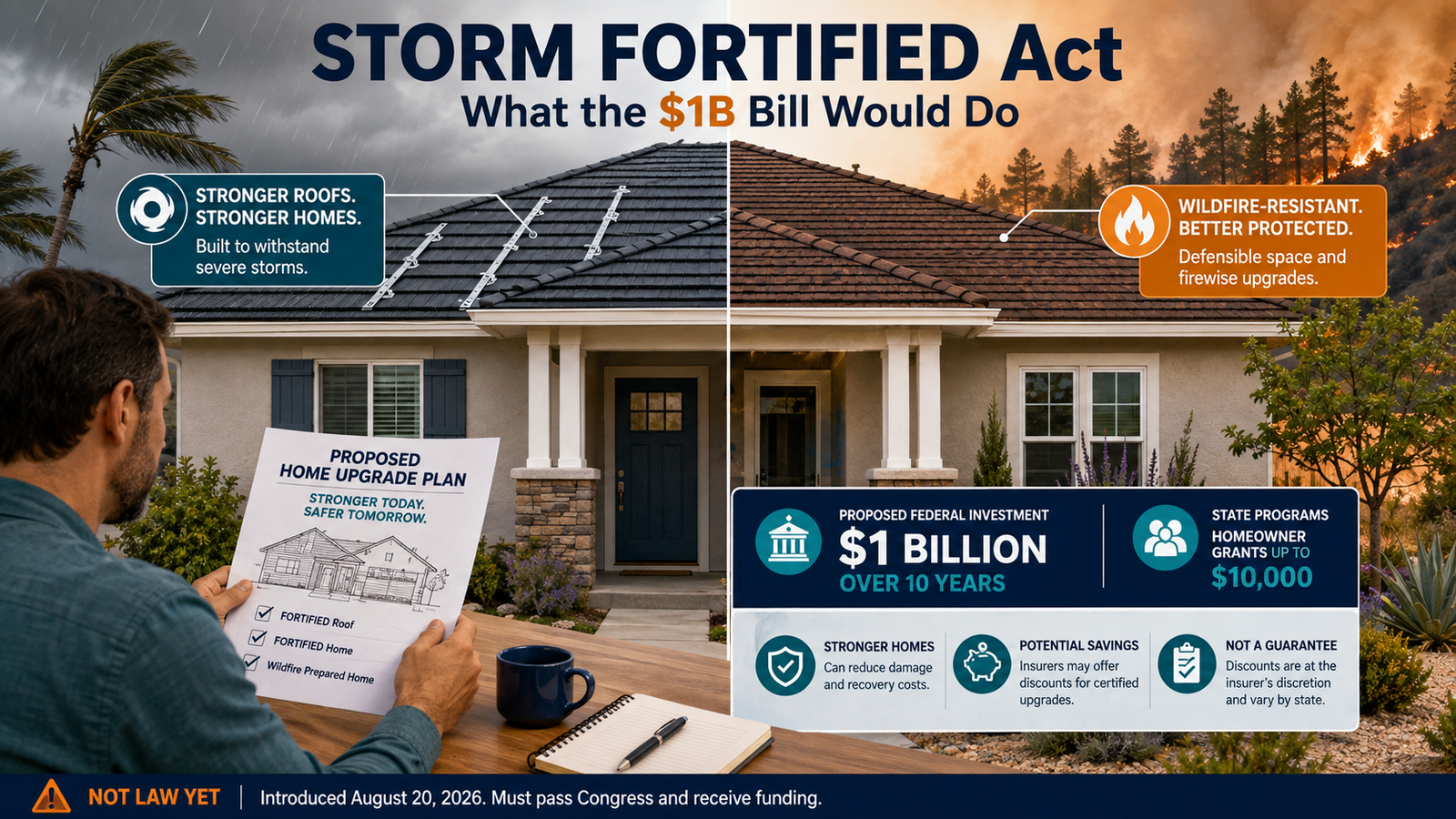
The bipartisan STORM FORTIFIED Act would authorize up to $1 billion over 10 years for state programs that help homeowners strengthen roofs and homes against storms and wildfires. The bill was introduced on August 20, 2026. It is not law, no federal homeowner application is open, and the proposal does not guarantee lower insurance premiums.
Key Facts
- The bill would authorize $100 million annually for fiscal years 2027 through 2036.
- Participating states could create homeowner grant programs for qualifying resilience projects.
- A state-set grant cap could not exceed $10,000 per project.
- New construction, condominiums and mobile homes would not qualify under the posted text.
- The proposal would encourage insurer recognition of certifications, but would not mandate a premium discount.
What Happened
Representatives Troy Carter of Louisiana, Mike Ezell of Mississippi and Salud Carbajal of California announced the bipartisan legislation on August 20.
Its full name is the Safeguarding Tomorrow through Ongoing Risk Mitigation FORTIFIED and Wildfire Prepared Act. The proposal would use the Federal Emergency Management Agency to help states finance projects meeting FORTIFIED Roof, FORTIFIED Home or Wildfire Prepared Home standards.
The measure must pass Congress and be signed into law. Congress would also need to provide funding through the appropriations process.
What the STORM FORTIFIED Act Would Authorize
The posted bill text would authorize $100 million for each fiscal year from 2027 through 2036. That equals up to $1 billion over the decade.
Authorization does not make money immediately available. Future appropriations would determine how much funding Congress actually provides.
Participating states would need to deposit at least 35% of their federal capitalization grant. A smaller contribution would reduce the federal award.
How the Money Would Reach Homeowners
The proposal is not a direct FEMA application for individual homeowners. FEMA would provide capitalization grants to participating states. Those states would establish revolving funds that could finance state-agency homeowner grant programs.
Each state could set its grant cap, but the amount could not exceed $10,000. Grant-supported work would need a qualified contractor and verification by a qualified evaluator.
The structure resembles FEMA’s existing Safeguarding Tomorrow Revolving Loan Fund program, which provides capitalization grants to eligible government entities rather than direct household payments. The bill would create a specialized route for certified home-hardening projects.
Who Could Qualify
The STORM FORTIFIED Act would leave many application details to participating states. The posted text sets several baseline conditions.
- The property generally must be the homeowner’s primary residence.
- The applicant must provide a homestead exemption, owner-occupancy classification or equivalent proof.
- A certified evaluator must find the structure suitable for the proposed work.
- The applicant must disclose other government assistance for the same improvements.
- New construction, condominiums and mobile homes would be excluded.
Insurance requirements would depend on the project and location. Wind coverage would generally apply to FORTIFIED Home work. Flood insurance would be required in a Special Flood Hazard Area, while fire coverage would generally apply to Wildfire Prepared Home projects in mapped wildfire areas.
States could create a route for uninsured homeowners when the work is reasonably intended to improve insurability or affordability.
How the 120% AMI Provision Would Work
For homeowners below 120% of area median income, a participating state agency would have to forgive any repayment or cost-share obligation attached to the grant. The threshold would vary because area median income uses local HUD data.
Households should not use one national income figure. The HUD income-limits data page shows that local benchmarks vary by county and metropolitan area.
Would the Upgrades Lower Insurance Premiums?
Possibly, but not automatically. The bill would direct FEMA to encourage state agencies to coordinate with insurers on actuarially justified discounts for qualifying certifications.
It would not order every insurer to offer a discount, set a national percentage or guarantee policy renewal. Any price change could depend on state law, the carrier, the property and other rating factors.
What Has Not Changed
No homeowner is entitled to a $10,000 federal grant today. No nationwide application portal, enrollment deadline or participating-state list exists. The proposal also would not prevent insurers from changing premiums or coverage under applicable state law.
Be cautious if a contractor claims the STORM FORTIFIED Act already guarantees federal money or insurance savings.
What Homeowners Should Do Now
- Do not pay an application fee for this proposed federal program.
- Check whether your state already offers a separate mitigation grant.
- Ask your insurer which verified upgrades may qualify for discounts before starting work.
- Confirm contractor licensing, certification requirements and written estimates.
- Save policies, inspections, receipts and proof of other assistance.
- Monitor Congress and FEMA for final legislation, funding and official guidance.
Bottom Line
The STORM FORTIFIED Act would authorize up to $1 billion for state-administered home-hardening programs, with homeowner grants capped at $10,000. It could help eligible households finance certified roof, wind and wildfire upgrades. For now, it remains proposed legislation, and neither funding nor premium savings are guaranteed.
Editorial disclaimer: This article provides general consumer information and is not legal, insurance or financial advice. Bill language, funding and eligibility rules may change during the legislative process.
Official Source Stack
Direct sources supporting the material claims in this report.
- Official agency release bipartisan legislation on August 20
- Official agency release posted bill text
- Official agency release Safeguarding Tomorrow Revolving Loan Fund program
- Official agency release HUD income-limits data page
This report provides general news and educational information for a U.S. audience. It is not individualized financial, credit, legal, tax, insurance or investment advice. Verify current procedures through the linked official sources.