Updated: August 21, 2026
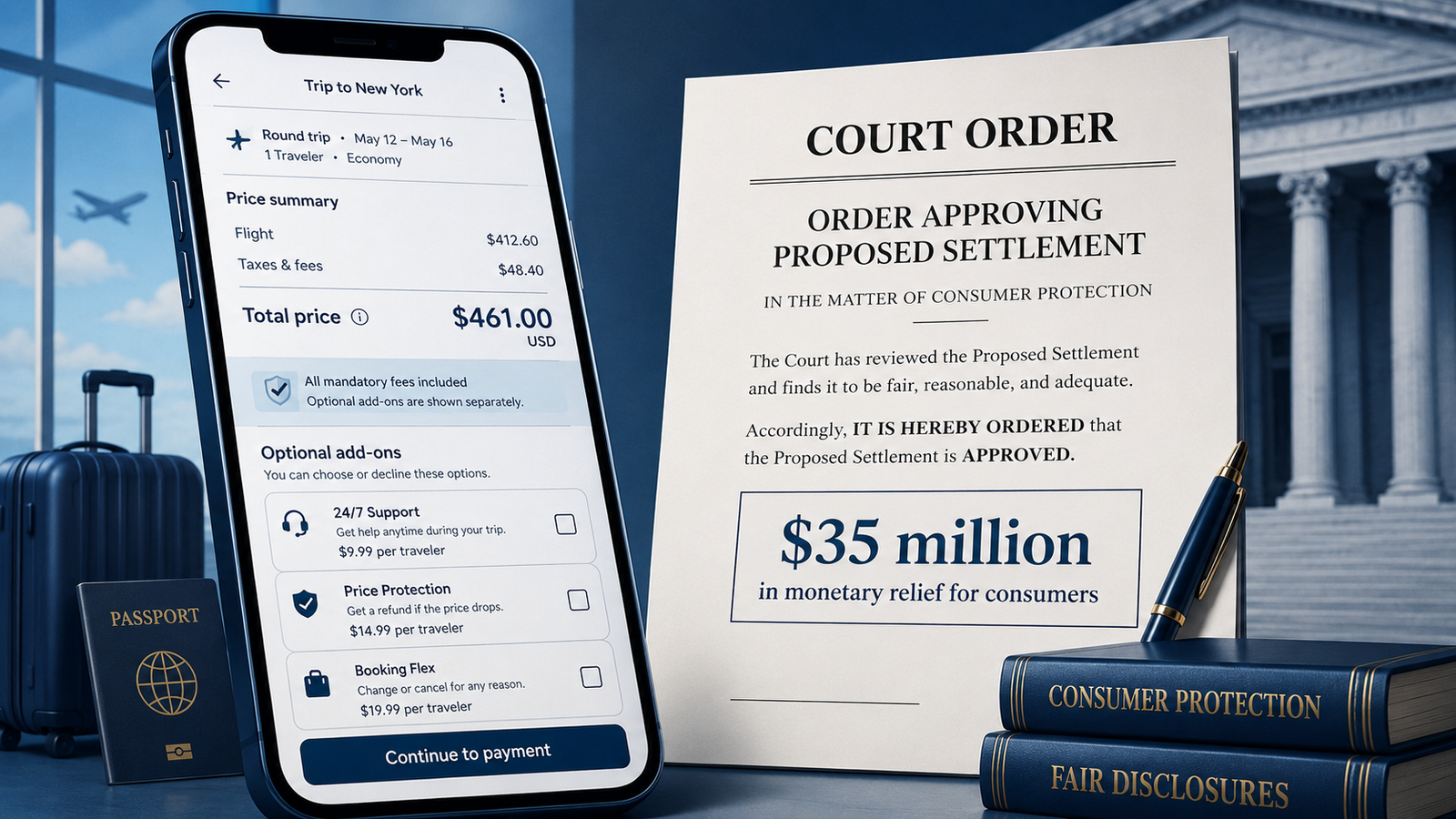
A federal court entered the Hopper FTC settlement order on August 20, turning a proposed agreement into an enforceable permanent injunction and $35 million monetary judgment. The order changes how Hopper must disclose prices, optional charges, refunds and product restrictions. It does not yet create a public refund claim form or guarantee that any particular customer will receive money.
Key Facts
- The U.S. District Court for the District of Massachusetts entered the stipulated order on August 20, 2026.
- Hopper Inc. and Hopper (USA) Inc. face a $35 million monetary judgment payable to the Federal Trade Commission.
- The order requires express informed consent before Hopper imposes each fee or charge.
- The FTC has not announced individual refund eligibility, payment amounts or a claims deadline.
What Happened
The FTC filed its complaint on July 2, 2026, against Canadian company Hopper Inc. and its Massachusetts subsidiary, Hopper (USA) Inc. The agency alleged that the travel-booking companies charged certain optional fees without adequate consent and misrepresented some prices and product benefits.
The proposed resolution required court approval. That changed on August 20, when the court entered the stipulated permanent injunction and monetary judgment. The FTC’s official Hopper case page records the new order but still labels the broader case “Pending.”
What the FTC Alleged
According to the FTC complaint filed July 2, Hopper presented “Tip” and VIP Support charges as optional while allegedly preselecting or inadequately disclosing them during parts of the booking process. The complaint also challenged claims about VIP Support response times and the limits of Price Freeze, also called Hold the Room.
Those remain allegations. The entered order states that the companies neither admit nor deny the complaint’s allegations, except for facts needed to establish the court’s jurisdiction.
What the Hopper FTC Settlement Changes
The Hopper FTC settlement does more than require payment. Its conduct provisions apply to Hopper travel-booking services and related add-ons covered by the order.
- Consent for every charge: Hopper must obtain an affirmative, unambiguous indication of consent after clearly disclosing the fee’s purpose, amount, optional status, recurrence, refundability and material limits.
- Clear total prices: When Hopper advertises or displays a price for a covered service, the total price must be clear and more prominent than other pricing information, subject to the order’s definitions.
- Accurate product claims: The companies cannot misrepresent fee details, refund terms, customer-support benefits or whether a product locks in a travel price or availability.
- Refund practices: Fees connected with a refunded, canceled, returned or uncompleted transaction generally must be refunded automatically unless each fee was clearly disclosed as nonrefundable. Charges imposed without express informed consent must be returned to the original payment method or in cash.
The companies must also maintain specified records, including consumer complaints, refund requests and material changes to app or website purchase flows.
Refund Status After the Hopper FTC Settlement
The monetary judgment is designed as consumer relief, but it is not the same as an announced payment program. The order allows the FTC or its designee to administer money for redress and related expenses. If direct payments are impracticable, remaining funds may be used for related relief, with unused money ultimately going to the U.S. Treasury.
As of August 21, the FTC’s active refund-program page does not list a Hopper program. No official source has published eligibility dates, payment amounts, a claims portal or a filing deadline. A past Hopper booking alone does not establish eligibility.
Who May Be Affected
The allegations concern consumers who used Hopper’s travel-booking services and encountered the disputed Tip, VIP Support or Price Freeze practices. The available documents do not yet define a refund class or identify which transaction dates will qualify for redress.
The order also should not be read as a refund for every airline ticket, hotel stay or rental-car booking made through Hopper. Eligibility, if the FTC launches a program, will depend on the agency’s records and distribution plan.
What Consumers Should Do Now
- Save Hopper booking confirmations, receipts, card statements and support messages showing the disputed charge.
- Review the final amount paid against the price and add-ons shown during checkout.
- Contact Hopper through its official support channel if an unresolved fee or refund issue remains.
- Monitor the FTC case page and refund page for an administrator, eligibility notice or payment announcement.
- Do not pay anyone who claims a fee is required to secure an FTC refund.
Suspected impersonation or a fraudulent refund offer can be reported through the FTC’s official ReportFraud portal. Avoid posting booking numbers, payment-card details or other sensitive information publicly.
Bottom Line
The court-entered Hopper FTC settlement makes the $35 million judgment and pricing-related restrictions enforceable. Its most immediate effect is on Hopper’s fee consent, total-price disclosures, product claims and refund handling. Consumers should preserve records and rely on FTC notices, but they should not assume that checks or a claim process have begun.
Related Fiscal Wire coverage: Doxo FTC settlement and consumer relief update and FTC personalized pricing proposal explained.
Editorial disclaimer: This report provides general consumer information and is not legal or financial advice. Refund eligibility and distribution details may change when the FTC issues additional notices.
Official Source Stack
Direct sources supporting the material claims in this report.
- Official agency release stipulated permanent injunction and monetary judgment
- Official agency release official Hopper case page
- Official agency release FTC complaint filed July 2
- Official agency release FTC’s active refund-program page
This report provides general news and educational information for a U.S. audience. It is not individualized financial, credit, legal, tax, insurance or investment advice. Verify current procedures through the linked official sources.